Industrial machines rely on stable and efficient power, yet traditional linear power supplies often fail to meet these requirements in demanding environments. Linear supplies waste energy as heat, take up large space, and cannot handle wide voltage fluctuations. In fast-moving industries, these limitations result in downtime, increased costs, and reduced reliability.
Industrial SMPS, or switched-mode power supply, solves these challenges. Switching power modules gives industries a modern alternative to outdated linear power supplies. It is compact, efficient, and reliable under heavy loads. It regulates voltage with precision and includes protection circuits for safe operation. It supports automation, robotics, OEM, and IOT systems. As industries demand higher efficiency and reduced space, knowing how SMPS works and how to select the right unit is essential.
In this guide, you will find out what industrial SMPS is, how it works, the different types, and its applications in modern industries.
TLDR
-
An industrial SMPS (Switched-Mode Power Supply) is an electronic device that efficiently converts AC or DC input into a stable, regulated DC output, ensuring precise voltage control and consistent power delivery even under varying load conditions.
-
It reduces energy loss, minimizes heat generation, and incorporates built-in protection features such as overvoltage, overcurrent, and short-circuit safeguards to keep connected equipment safe and reliable.
-
Industrial SMPS units are widely used across automation, robotics, IoT systems, CNC machines, elevators, escalators, and other industrial sectors where compact, high-efficiency, and reliable power is critical for smooth operations.
What is SMPS?
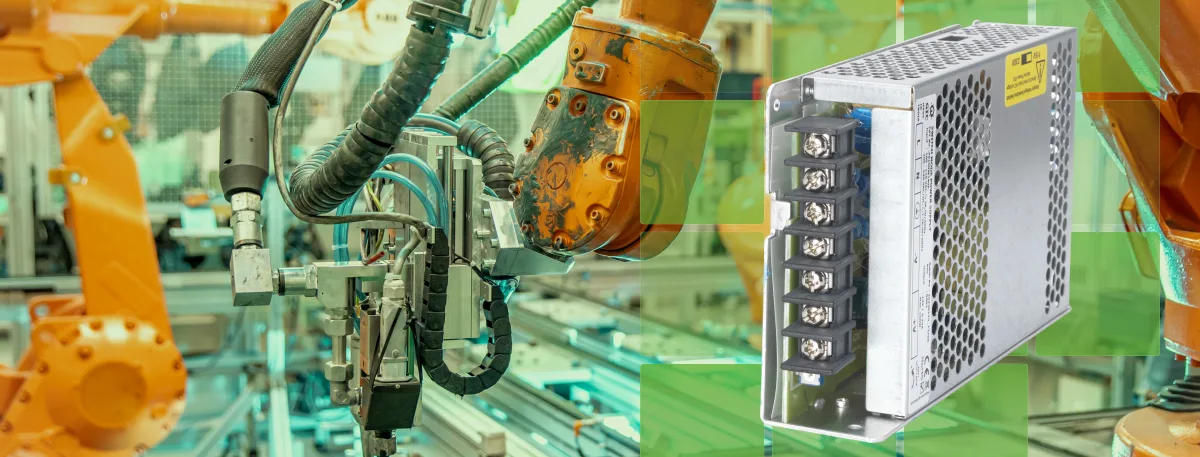
An industrial SMPS (Switched-Mode Power Supply) is an electronic device that converts AC or DC input into a stable DC output with high efficiency and precision. It regulates voltage using switching regulators, inductors, capacitors, and transformers, ensuring minimal energy loss and reduced heat generation.
Compared to traditional linear power supplies, an SMPS delivers power more efficiently and integrates easily into machines, control panels, and automation systems. It provides consistent and precise power, ensuring reliability even in harsh factory or production environments.
Switching power supply is commonly used in automation, robotics, and industrial instrumentation.
Key Components of an Industrial Switching Power Module
The Switching power supply circuit consists of various components which are necessary for circuit designers and engineers. It includes the following components:
- Input Filter: Reduces electromagnetic interference (EMI) and smooths incoming voltage.
- Rectifier: Converts AC input into DC voltage for the switching stage.
- Switching Transistors: High-frequency switches that regulate voltage efficiently.
- Transformer: Provides electrical isolation and adjusts voltage levels.
- Output Rectifiers & Filters: Convert high-frequency AC back to a stable DC output.
- Control Circuitry: Monitors voltage, current, and system performance for precision.
- Protection Circuits: Safeguard against overvoltage, overcurrent, and short circuits.
- Cooling System: Heat sinks or fans prevent overheating and maintain reliability.
Read more: The Impact of Industrial Power Supply Efficiency on Overall Energy Costs
What Are the Different Types of SMPS?
There are six different types of switch mode power supply that serve specific purposes across electronics and industrial systems. Choosing the right type ensures reliable performance and energy efficiency.
- AC to DC Converters – Convert alternating current to stable direct current, powering PCs, televisions, and industrial control systems.
- DC to DC Regulators – Adjust voltage levels for battery-powered devices, embedded systems, and portable electronics.
- Flyback Modules – Compact, cost-effective, and electrically isolated for low-power and sensitive electronics.
- Forward Converters – Efficient voltage regulation for higher power industrial machinery and equipment.
- Push-Pull Configurations – Medium to high power applications, ideal for audio systems and power amplifiers.
- Half-Bridge & Full-Bridge Units – High-wattage setups like electric vehicles and large inverters, offering efficiency and scalability.
How Does SMPS Work?
The working principle of an switched power module (SMPS) reveals why it’s highly efficient and widely used in industrial power systems. The process can be broken down into several key stages:
- Input Rectification and Filtering: AC input from the mains is first converted into DC using a rectifier circuit. The resulting unregulated DC passes through filters to remove noise and spikes, ensuring a clean voltage for the switching stage.
- High-Frequency Switching: The filtered DC is fed to a high-speed switching circuit, typically using MOSFETs or IGBTs. Operating at tens of kilohertz to several megahertz, these transistors turn the current on and off rapidly. This high-frequency operation enables the use of smaller transformers, reducing the overall size of the Switching Power Modules.
- Voltage Transformation: The high-frequency current passes through a compact transformer that steps the voltage up or down according to the requirement. Industrial-grade transformers provide both voltage conversion and galvanic isolation, protecting downstream electronics.
- Output Rectification and Filtering: After transformation, the AC voltage is rectified again to DC and filtered to smooth out ripples, delivering a stable, regulated DC output suitable for sensitive industrial devices.
- Feedback and Pulse-Width Modulation (PWM) Control: A feedback loop continuously monitors the output voltage and adjusts the switching duty cycle via PWM. This ensures precise regulation even with variable loads, keeping devices like PLCs, sensors, and communication modules safe and operational.
- Noise Reduction and EMI Compliance: Switched power module units include filtering circuits to minimize electromagnetic interference, ensuring compliance with EMC standards. This is crucial in factories, laboratories, or smart warehouses where multiple electronic systems operate close together.
At the core, Switching power supply achieves high efficiency by rapidly switching power, reducing heat loss, and shrinking magnetic components such as transformers and inductors. The combination of compact design, electrical isolation, precise voltage control, and EMI mitigation makes switching power module indispensable for reliable, high-performance power delivery.
Read more: Power Factor Correction Techniques in SMPS for Improved Efficiency
What Are the Benefits of Switching Power Supply?
The benefits of industrial SMPS are as follows:
- High Efficiency: Minimizes power wastage and heat output, supporting smooth operation of industrial machines, automation systems, and electronic devices.
- Compact Size & Lightweight: Delivers high power density, making it suitable for control panels, embedded electronics, and machinery where space is limited.
- Wide Input Voltage Range: Functions reliably across varying voltages, perfect for manufacturing plants, factories, and diverse industrial environments.
- Protection Functions: Offers built-in overvoltage, overcurrent, and short-circuit safeguards, keeping PLCs, motors, and sensors secure.
- Industrial Durability: Engineered to handle heavy loads, voltage fluctuations, and harsh operating conditions in demanding industrial setups.
- Electrical Isolation: Includes high-frequency transformers to protect downstream equipment, instrumentation, and automated systems from electrical surges.
Applications of Switch-Mode Power Supplies
The industrial applications of switched power module span multiple sectors, ensuring energy-efficient and stable operation.
- Industrial Automation: Switch-mode power units supply stable and efficient energy to PLCs, conveyor belts, and automated control systems, ensuring precise machine operations, minimal downtime, and optimized power usage.
- Elevators: Power conversion modules deliver reliable DC power to elevator motors, sensors, and control circuits, guaranteeing smooth rides, accurate floor positioning, and adherence to safety standards.
- Escalators: High-efficiency power supplies maintain consistent energy for escalator motors, sensors, and lighting, reducing maintenance requirements while keeping passengers safe.
- Machine Industry: Industrial power converters provide regulated voltage to CNC machines, lathes, presses, and milling equipment, enhancing operational accuracy, reducing wear, and extending machinery lifespan.
- Robotics Systems: Advanced power regulators drive robotic arms, assembly line robots, and automated pick-and-place machines, enabling precise movements, reliable task execution, and seamless integration with industrial networks.
- IoT Systems: Efficient industrial power units energize IoT devices, smart sensors, and controllers in factories and commercial setups, supporting real-time monitoring, predictive maintenance, and energy-conscious operation.
How to Choose the Right Industrial SMPS?
Selecting a reliable switching power module is essential for smooth operation in industrial, commercial, or automation systems. Here are the key factors:
- Input Voltage Range – Ensure the power supply matches your available source. Some environments use standard AC (110V or 220V), while others—like automation panels or renewable energy setups—may require DC input. Converters with wide input tolerance (e.g., 85–264V AC or 127–375V DC) maintain consistent performance under fluctuating voltage conditions.
- Output Requirements – Verify that the voltage and current align with your devices. Undersized units can trigger system resets, while oversized units waste energy. Accurate knowledge of peak and continuous load is crucial for sensors, relays, and industrial controllers.
- Size and Mounting Options – Choose a form factor that suits your setup. DIN-rail units save space in control cabinets, whereas open-frame or enclosed modules integrate better into custom housings. Proper mounting ensures efficient heat dissipation and easy maintenance.
- Safety Features and Compliance – Certified converters (CE, RoHS, UL) guarantee safety and environmental adherence. Built-in protections such as overvoltage, short-circuit, and over-temperature safeguards extend the life of both the power supply and connected equipment.
- Scalability and Lifecycle Considerations – For long-term projects or OEM deployments, modular designs with standard footprints simplify future upgrades and reduce downtime, helping maintain operational efficiency and lower costs.
Read more: Understanding Efficiency Ratings in GIC SMPS
Why Choose GIC for Power Supplies?
GIC power supplies provide compact, reliable, and energy-efficient power for industrial and commercial applications. With excellent load and line regulation, low ripple, and high noise immunity, they ensure stable performance across diverse environments. Built-in overload, short circuit, and overvoltage protection keep devices safe and prolong equipment life.
Designed for space-efficient DIN rail or panel mounting, these units deliver high efficiency, low power loss, and support wide input voltage ranges. Rugged construction enables operation in extreme temperatures and harsh industrial conditions. Applications include solar and renewable energy systems, SCADA and control panels, HVAC, elevators and escalators, water treatment plants, OEM manufacturing, and building automation.
With CE, UKCA & RoHS compliance, GIC power supplies guarantee durable, scalable, and high-quality power solutions for every industrial need.