A packaging line only works if its machines act at the right moment, every time. Filling, capping, sealing, labeling – each step has to land within a narrow window, because a delay at one station throws everything downstream. Miss that window and you get underfilled packs, crooked caps, weak seals, or labels stuck at an angle.
As lines have gotten faster and product variety has grown, there’s less room for timing to drift. That’s where a timer relay, a PLC controller, and synchronized drives come in – they’re what keep a line doing what it was built to do, run after run.
This blog looks at what timing precision actually means on a packaging line, how it’s controlled, why machine synchronization matters, what happens when timing slips, and where it counts most on the floor.
Timing precision defines how well a packaging line performs
A packaging line is really a chain of stations, each handing off to the next. Timing precision means every station fires at the exact point in its cycle – not a beat early, not a beat late. In practice, that covers things like:
- When a conveyor section starts moving after the one before it clears, often governed by a simple timer relay
- How long a filling nozzle stays open
- The gap between a carton forming and being loaded, timed through a digital timer switch
- How long sealing jaws stay closed on a pouch or carton
- The spacing between products arriving at a labeling head
Hold these steady and the line runs the way it was engineered to. Let them drift, even slightly, and you’ll see a few underfilled containers, weak seals, skewed labels, or a jammed conveyor.
Timer Relays and PLC Timers control timing across the line
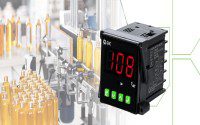
An on-delay timer relay switches on after a set delay; an off-delay timer holds a circuit active a while after power drops. A standalone programmable timer relay handles a machine with one or two simple delays, while safety circuits like emergency stops usually rely on hardwired versions built to specific safety standards.
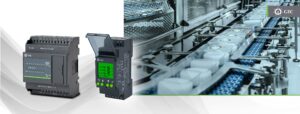
Once a line has many stations to coordinate, a programmable logic controller takes over the bigger picture – keeping the conveyor at the right speed and timing loading and unloading correctly. This is really the backbone of industrial PLC automation on the floor: a single controller managing dozens of timed steps that would be unwieldy to run on relays alone.
Servo systems tend to handle the finer timing, like sealing and cutting, while the controller runs infeed, carton erection, filling, and discharge as one coordinated sequence.
Synchronized machines keep every station working in step
Every station is only as useful as its timing relative to the others. The filling machine speed depends on product viscosity and fill precision; the capper must match that pace, or you get overflow; the labeler must keep up without losing placement accuracy. One station out of step, and you’ll see spillage, crooked caps, or missed labels almost right away.
Much of this coordination runs through an interface relay module, or industrial relay interface, which isolates signals and switches cleanly between the controller, sensors, and actuators. A PLC relay module typically sits between the controller and the motors or drives it’s actually operating, so the timing signal reaches the right point without interference.
Most discrete machines run on a repeating indexed cycle – a set sequence of actions, each happening while the machine is momentarily still. That gives tight control over individual steps, but it also means a timing error anywhere in the cycle ripples through the whole line fast. Sealing and closing steps depend on this most: flaps need to fold and bond on schedule, or the seal doesn’t form properly. It’s a chain – each station has to finish inside its window for the next to do its job right.
Timing errors lead to downtime and lower OEE
When timing breaks down, you lose production time, generate rejects, and take a direct hit to Overall Equipment Effectiveness. OEE – a product of availability, performance, and quality – is the standard way to track how a packaging line is actually performing. A score of 75 to 85 percent is considered strong; anything under 65 percent signals real room for improvement.
An energy monitoring device or voltage monitoring relay, part of a broader industrial monitoring system, is often what catches these faults early – tracking carton presence, count, and seal quality so a drifting timer relay or a poorly tuned PLC sequence gets flagged before it becomes a full stoppage.
Working out what a stoppage actually costs is straightforward: take the units the line couldn’t produce during the stop and multiply by the gross profit per unit. Even small, repeated timing faults add up fast over a year, and the cost isn’t just downtime – underfilled packs, weak seals, and misapplied labels mean rework and wasted material too.
Precise timing applies across every stage of the packaging process
Timing precision matters most wherever machines have to hand off a product within a tight window – which is most of packaging, across manufacturing, food and beverage, and material handling alike.
- Conveyor systems, so one section doesn’t start before the previous one clears
- Filling and capping stations, where the cap has to arrive within the same window as the fill
- Carton forming and sealing stations, where flaps fold and bond on a set cycle
- Labeling stations, where the product needs to be positioned before the label goes on
- Start-stop sequencing across the line, so downstream machines restart with enough delay to avoid a queue backing up
A timer relay handles the simple, local delays; a PLC controller coordinates the bigger picture; an interface relay module and industrial monitoring system keep an eye on the process throughout. Together, that’s what keeps a packaging line running the way it’s meant to, cycle after cycle.
Conclusion
Timing isn’t a minor detail on a packaging line – it’s what holds filling, sealing, capping, and labeling together as one working system. Whether it’s a single timer relay managing one delay or a PLC controller coordinating dozens of stations, the goal stays the same: every action happens exactly when it should.
For manufacturers looking at new lines or upgrades, that makes the choice of timers, interface relays, programmable logic controllers, and monitoring devices worth real thought – these are the components that decide how well the rest of the line actually performs.