Industrial machines need stable and efficient power to operate reliably. Switched-mode power supplies (SMPS) deliver precise voltage control, reduce energy loss, and generate less heat, making them ideal for automation, manufacturing, and factory equipment.
However, choosing the wrong type of SMPS can cause overheating, production delays, and increased maintenance costs, making selection a critical decision for any facility. In this blog, you will discover the different types of industrial SMPS, how they work, and what to consider when selecting the right solution for your operations.
TL;DR
-
Industrial SMPS ensures stable, efficient power for factory equipment, helping reduce heat, energy loss, and downtime.
-
The four main SMPS types are AC to DC converters, DC to DC converters, flyback converters, and forward converters.
-
Choosing the right SMPS depends on power needs, voltage range, isolation requirements, efficiency, and reliability for industrial operations.
What are the four types of SMPS?
There are several types of industrial SMPS, but the four main types of SMPS are:
- AC to DC Converter (Off-Line Converter)
- DC to DC Converter
- Flyback Converter
- Forward Converter
Read more: What is Industrial SMPS?
1. AC to DC Converter (Off-Line Converter)
The AC-to-DC converter is the most common industrial SMPS. It transforms alternating current (AC) input into regulated direct current (DC) output suitable for industrial machinery and electronics.
Working:
- Rectification: Converts AC input into unregulated DC (raw power).
- Switching: Uses high-speed transistor switches to chop DC into high-frequency AC.
- Transformation: Adjusts voltage levels via a transformer.
- Rectification and Filtering: Converts high-frequency AC back to smooth DC for final output.
Applications:
- Industrial automation systems
- CNC machines
- Factory lighting and control panels
- Powering low-voltage industrial electronics
Advantages:
- Converts standard AC supply to usable DC efficiently
- Supports a wide input voltage range
- Compact design suitable for industrial environments
- Reduces energy loss compared to linear power supplies
2. DC to DC Converter
DC-to-DC converters adjust DC voltage levels to meet the requirements of industrial devices. They are used when devices need stable DC from DC input, commonly in battery-powered or low-voltage systems.
Types & Working:
- Buck Converter (Step-Down): Reduces input voltage to a lower output voltage using an inductor and switching transistor.
- Boost Converter (Step-Up): Increases input voltage to a higher output voltage with inductors and switching control.
- Buck-Boost Converter: Can step up or step down voltage depending on input, providing stable output despite fluctuations.
| Converter Type | Function | Application |
|---|---|---|
| Buck Converter | Step-down voltage | Battery chargers, low-power devices |
| Boost Converter | Step-up voltage | Solar power systems, LED drivers |
| Buck-Boost Converter | Step-up or step-down | Automotive systems, portable devices |
Applications:
- Industrial battery management systems
- PLCs and industrial controllers
- Robotics and automation devices
- Communication and monitoring equipment
Advantages:
- High efficiency in voltage regulation
- Flexible voltage output for different industrial requirements
- Compact and lightweight design
- Handles fluctuating input voltages without affecting output
3. Flyback Converter
The Flyback Converter is an isolated SMPS for low-power industrial and consumer applications, storing energy in a transformer during the “on” phase and releasing it during the “off” phase.
Energy is stored in the transformer when the switch is on and released to the output when off, with voltage adjusted through the transformer turns ratio.
Applications:
- Industrial sensors and measurement devices
- Small industrial controllers
- Low-power automation modules
- Multi-output industrial circuits
Advantages:
- Provides isolation for safety in industrial environments
- Supports multiple output voltages from a single input
- Compact and cost-effective for low-power applications
- Efficient energy transfer at low to medium power levels
4. Forward Converter
The Forward Converter is an isolated SMPS that continuously transfers energy to the output during the “on” phase, suitable for medium to high-power industrial applications.
Energy flows directly from input to output when the switch is on. Additional windings and components reset the transformer for the next cycle, ensuring continuous operation.
Applications:
- Industrial automation systems
- Process control units
- Motor drives
- Mid-range industrial electronics
Advantages:
- Higher efficiency at medium power levels compared to flyback converters
- Provides electrical isolation for safety
- Suitable for continuous and steady power supply
- Compact for medium-power industrial setups
Which Type of SMPS is Better for Industrial Applications?
Different SMPS types have unique advantages and limitations. The “better” choice depends on the power requirements, device specifications, and application scenario.
Industrial Applications:
- Flyback Converter: Ideal for low to medium-power industrial equipment. It provides high voltage isolation and stable output, making it suitable for automation modules, sensors, and control systems.
- Buck-Boost Converter: Common in factory equipment and industrial automation. It handles fluctuating input voltages and provides flexible output voltage levels for diverse machinery.
Read more: Understanding Efficiency Ratings in GIC SMPS
Key Factors to Consider When Choosing an Industrial SMPS
There are several key factors to consider when selecting the right SMPS for industrial use:
- Power Requirements: Select the SMPS type based on the power demand of your equipment. Low-power devices can use buck converters, while high-power industrial machinery often requires flyback or buck-boost converters to handle complex loads efficiently.
- Voltage Range: Identify both input and output voltage needs. A boost converter suits low-input, high-output systems, whereas a buck SMPS works best for high-input, low-output setups. For systems that require flexible voltage control, a buck-boost converter is ideal.
- Isolation Requirements: In industrial control systems or high-voltage equipment, choose an SMPS with strong isolation—such as a flyback converter—to ensure electrical safety and circuit stability.
- Efficiency and Cost: Efficiency directly impacts energy savings and heat management. Buck converters are cost-effective, while boost and flyback models offer higher efficiency and better voltage regulation at a higher cost.
- Reliability and Compliance: Opt for SMPS units that meet industrial safety standards (IEC, UL, or CE). Durable designs with thermal protection, overload control, and long operational life help maintain consistent plant performance.
Why Choose GIC for Power Supplies?
GIC power supplies provide compact, reliable, and energy-efficient power for industrial and commercial applications. With excellent load and line regulation, low ripple, and high noise immunity, they ensure stable performance across diverse environments. Built-in overload, short circuit, and overvoltage protection keep devices safe and prolong equipment life.
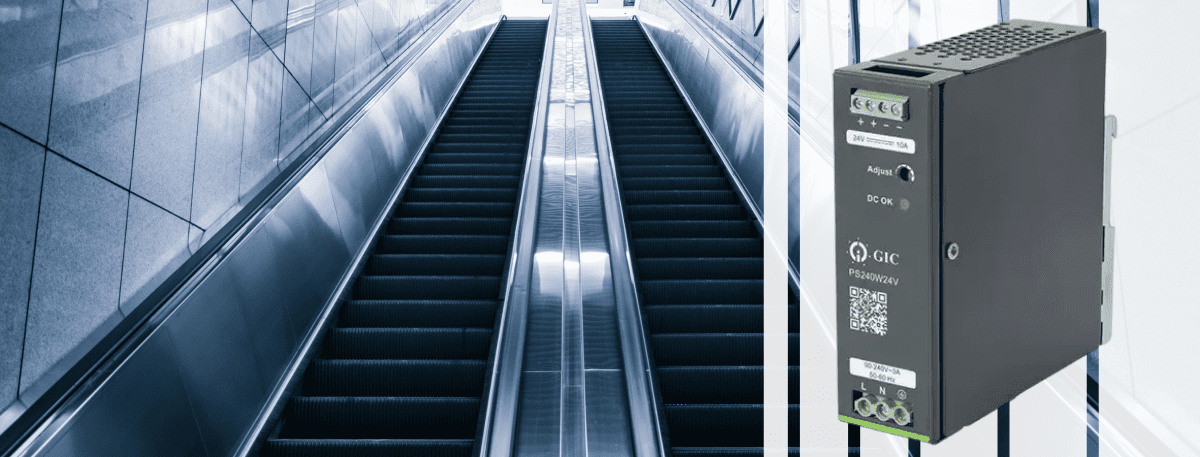
Designed for space-efficient DIN rail or panel mounting, these units deliver high efficiency, low power loss, and support wide input voltage ranges. Rugged construction enables operation in extreme temperatures and harsh industrial conditions. Applications include solar and renewable energy systems, SCADA and control panels, HVAC, elevators and escalators, water treatment plants, OEM manufacturing, and building automation.
With CE, UKCA & RoHS compliance, GIC power supplies guarantee durable, scalable, and high-quality power solutions for every industrial need.