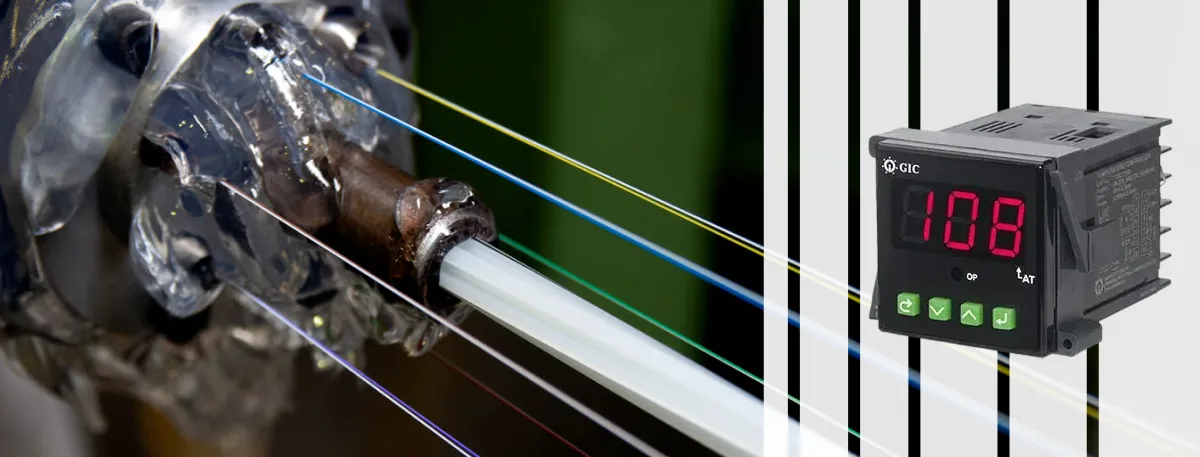
An RTD or resistance temperature detector is a temperature sensor that measures heat by detecting changes in electrical resistance of a metal element. The resistance increases in a predictable and stable way as temperature rises, allowing accurate temperature measurement.
Temperature measurement in industrial processes plays a critical role in maintaining product quality, safety, and overall efficiency. Even small variations can impact performance, which makes accurate and stable sensing essential for reliable control.
Among the commonly used sensors, RTDs and thermocouples are widely applied in temperature control systems. Each works on a different principle and is selected based on accuracy, response, and operating conditions. In a temperature controller, the choice of sensor directly affects how precisely the system can maintain the setpoint.
In this blog, you will learn what an RTD is, how it works, and why it is often preferred for applications that require stable, accurate temperature measurement.
TL;DR
- RTDs are temperature sensors that measure heat using resistance change and are known for high accuracy and stability in industrial systems.
- They are available in different types such as thin film, wire wound, and coiled element, depending on accuracy and application needs.
- RTDs use metals like platinum, nickel, and copper, and come in 2 wire, 3 wire, and 4 wire configurations that balance cost, accuracy, and lead resistance error.
What is an RTD?
An RTD, or Resistance Temperature Detector, is a temperature sensor that measures temperature by detecting changes in the electrical resistance of a metal element. As the temperature increases, the resistance of the element increases in a predictable and repeatable manner.
How does an RTD work?
An RTD works by measuring how the electrical resistance of a metal element changes with temperature.
The process follows this sequence:
- Temperature changes affect the metal element
- Resistance of the element increases or decreases
- A small current is passed through the RTD
- Voltage or resistance is measured by the system
- Measured value is compared with calibration data
- Temperature controller converts it into actual temperature
- Controller adjusts output to maintain setpoint
What are the types of RTDs?
RTDs are classified based on construction, wiring configuration, and sensing material. Each type is designed to meet specific accuracy, response, and installation needs.
- Thin film RTD: Compact design with fast response, suitable for space-constrained industrial systems
- Wire wound RTD: High accuracy and stability, used in precision measurement applications
- Coiled element RTD: Designed for durability, handles thermal expansion in cyclic processes
What metals are used in RTDs?
The sensing element in an RTD is made from pure metals with stable resistance properties. The choice of metal determines accuracy, temperature range, and long term stability.
Platinum (Pt100, Pt1000)
Platinum is the most widely used RTD material due to its stable and linear resistance characteristics.
- Standard resistance: 100 ohms at 0°C (Pt100), 1000 ohms at 0°C (Pt1000)
- Temperature coefficient: approximately 0.00385 ohms per ohm per °C
- Temperature range: –200°C to 600°C
- Key advantage: high accuracy, excellent stability, low drift
Nickel (Ni100, Ni120)
Nickel offers higher sensitivity but less stability compared to platinum.
- Standard resistance: 100 ohms or 120 ohms at 0°C
- Higher temperature coefficient than platinum
- Temperature range: -80°C to 260°C
- Limitation: non-linear response and higher drift
Copper (Cu10, Cu50)
Copper provides a very linear resistance to temperature relationship but operates in a limited range.
- Standard resistance: 10 ohms or 50 ohms at 0°C
- Temperature range: -200°C to 150°C
- Limitation: prone to oxidation and corrosion
What are RTD wire configurations?
RTDs are connected to temperature controllers using different wiring methods. The configuration affects how resistance is measured and how much error is introduced by the lead wires.
- 2 wire RTD: Simple connection, but includes lead resistance error
- 3-wire RTD: Compensates for lead resistance, widely used in industrial systems
- 4-wire RTD: Eliminates lead resistance, used for high precision measurement
How does an RTD help in a temperature controller?
An RTD continuously sends accurate temperature data to the controller.
The controller:
- Reads RTD resistance signal
- Converts it into temperature value
- Compares it with setpoint
- Calculates deviation
- Adjusts heating or cooling output
Industrial applications of RTDs
RTDs are used in industries where accurate temperature measurement is critical for process stability.
- Manufacturing and process industries
- Used in plastic molding, metal processing, and chemical production for stable thermal control.
- HVAC systems
- Used for heating and cooling regulation with energy efficient performance.
- Food and pharmaceutical industry
- Ensures safe temperature control in processing, storage, and compliance systems.
- Power and energy sector
- Monitors equipment like turbines and generators to prevent overheating.
- Laboratory and calibration systems
- Used in high precision measurement environments for accurate testing.
Advantages of RTDs
- High accuracy measurement
Provides precise temperature readings suitable for industrial control systems. - Excellent stability
Maintains consistent performance over long periods. - Repeatability
Produces the same output under identical conditions. - Reliable feedback
Improves temperature controller performance and process stability.
Limitations of RTDs
- Higher cost
More expensive than basic temperature sensors. - Slower response
Slower than thermocouples in fast changing environments. - Limited high temperature range
Not suitable for extremely high temperature applications.
Conclusion
RTDs are one of the most reliable temperature sensors used in industrial systems where accuracy and stability directly affect process quality. They provide precise and repeatable measurements by using predictable resistance changes in metal elements like platinum, nickel, and copper.
Different RTD types and wire configurations are designed to balance accuracy, cost, and installation complexity. From simple monitoring systems to high precision calibration environments, RTDs support a wide range of industrial applications. Their strong stability and compatibility with temperature controllers make them essential for consistent thermal regulation in modern automation systems.