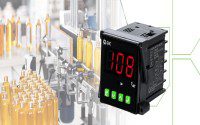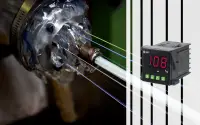
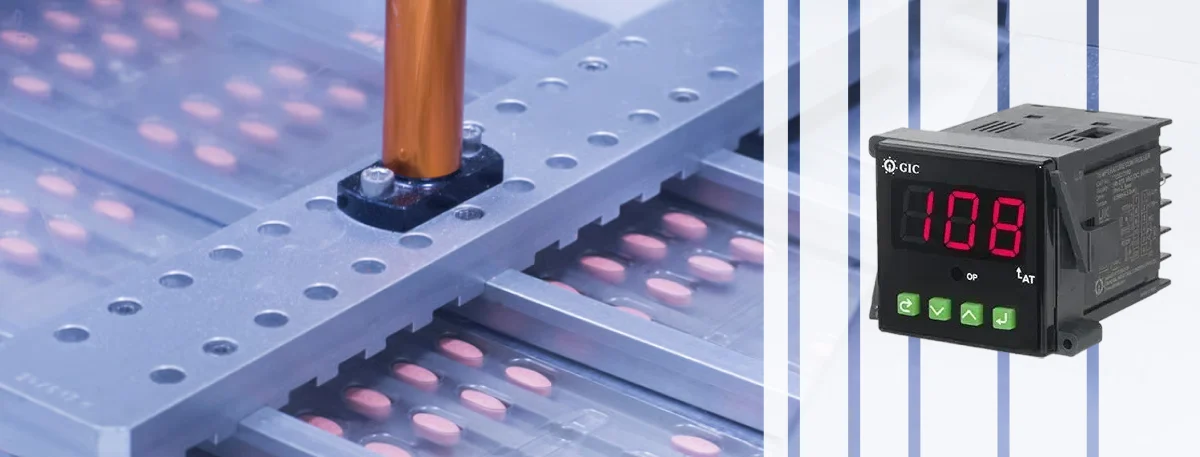
The rise of industrialization and advancement in automated systems has increased the demand for precise temperature regulation across manufacturing, food processing, and electronics industries. Even a 2-degree variation can affect product quality, safety, and operational efficiency.
Temperature controllers address this challenge by maintaining a consistent setpoint through controlled heating or cooling actions. Common types include On-Off controllers for basic control, Proportional controllers for improved stability, PI controllers for eliminating steady state error, and PID controllers for high precision and fast response.
In this guide you will get to know how each type works, its advantages, and where each one fits best to ensure optimal performance in different applications.
TL;DR
- Temperature controllers maintain stable thermal regulation by continuously monitoring the process variable and adjusting heating or cooling output through a control loop.
- The main types of temperature controllers include On Off, Proportional, PI, PD, PID, and Feedforward controllers, each offering different levels of accuracy, response speed, and process stability.
- PID controllers provide the highest precision and are widely used in industrial automation systems, while simpler controllers like On Off are best suited for basic heating applications.
What are the different types of temperature controllers?
The main types of temperature controllers are On Off, Proportional, PI, PD, PID, and Feedforward controllers, each designed for different levels of temperature accuracy, system stability, and industrial process control.
Read more: History of Temperature Controllers
On Off Controller
An on-off temperature controller switches the output fully on or fully off based on whether the measured temperature crosses the setpoint, making it the simplest form of temperature regulation with binary control action.
Origin and development
On-off control is the earliest form of automatic control, developed in the late 19th century during the expansion of industrial heating systems. It evolved from basic thermostat designs used in steam engines and early electrical heating devices.
How it works
The controller continuously compares the measured temperature with the setpoint. When the temperature drops below the setpoint, the controller turns the output fully on to activate heating. When the temperature exceeds the setpoint, the output turns fully off. This repeated switching creates a cycle of heating and cooling around the setpoint.
Advantages
- Low cost with minimal hardware requirements
- Simple installation and operation
- Reliable for non-critical applications
- No complex tuning required
Limitations
- Causes temperature oscillation around setpoint
- Poor accuracy with fluctuations of 2 to 10 degrees
- Not suitable for sensitive or precision systems
Use cases
- Domestic water heaters
- Refrigerators and freezers
- Small ovens and basic heating systems
Proportional Controller
A Proportional controller adjusts output in direct proportion to the difference between the setpoint and actual temperature, reducing oscillations and improving system stability compared to On Off control.
Origin and development
Proportional control was formalized in the early 20th century as part of classical control theory and became widely adopted between 1920 and 1940 with industrial automation growth.
How it works
The controller calculates the difference between the setpoint and the measured temperature, known as error. It then adjusts the output proportionally within a defined band. A larger error results in higher output, while a smaller error reduces output. As the temperature approaches the setpoint, the output gradually decreases instead of switching abruptly.
Advantages
- Reduces oscillation significantly
- Provides smoother control response
- Improves system stability
Limitations
- Cannot eliminate the steady state error completely
- Requires tuning of the proportional band
- Performance depends on system characteristics
Use cases
- Industrial ovens
- Food processing equipment
- Plastic molding machines
PI Controller
A PI controller combines proportional control with integral action to eliminate steady state error by continuously correcting accumulated deviations from the setpoint, ensuring the system reaches and maintains the exact target temperature.
Origin and development
Integral control was introduced in the 1930s to solve offset issues found in proportional systems. It became widely implemented by the 1950s across chemical processing, oil refining, and thermal systems.
How it works
The PI controller first applies proportional action to respond to the current temperature error. It then applies integral action, which continuously sums past errors over time. This accumulated value increases or decreases the output until the error is fully eliminated. As a result, the system not only approaches the setpoint but also stays exactly at that value without offset.
Advantages
- Eliminates steady state error completely
- Maintains exact setpoint over long durations
- Improves process consistency
- Works well in slow response systems
Limitations
- Slower response compared to proportional control
- Can cause overshoot due to accumulated correction
- Integral windup can reduce stability
- Requires tuning of integral parameter
Use cases
- Industrial furnaces
- Chemical reactors
- HVAC temperature regulation systems
Read more: Common PID Temperature Controller Problems and Solutions
PD Controller
A PD controller combines proportional and derivative control to improve response speed and reduce overshoot by predicting future temperature trends based on the rate of change of error.
Origin and development
Derivative control emerged during the 1930s and 1940s as part of classical control theory and became important in systems requiring fast response.
How it works
The PD controller responds to the current error using proportional action while simultaneously calculating how quickly the temperature is changing. This rate of change allows the controller to predict future behavior. Based on this prediction, it adjusts the output earlier to slow down the system before it reaches the setpoint, which reduces overshoot and stabilizes the response.
Advantages
- Faster response to temperature changes
- Reduces overshoot significantly
- Improves damping and stability
- Useful in dynamic systems
Limitations
- Cannot eliminate steady state error
- Sensitive to noise in signals
- Requires filtering for stable operation
- Rarely used alone in temperature systems
Use cases
- Systems with rapid temperature variation
- Precision mechanical systems
- Processes requiring minimal overshoot
PID Controller
A PID controller integrates proportional, integral, and derivative control to deliver precise, stable, and fast temperature regulation by minimizing error, eliminating offset, and predicting system behavior.
Origin and development
PID control was formalized in 1922 by Nicolas Minorsky and became an industry standard by the 1950s with the growth of automation.
How it works
The controller combines three actions. The proportional part reacts to current error, the integral part eliminates accumulated past error, and the derivative part predicts future error based on the rate of change. By continuously balancing these three components, the controller maintains a stable temperature with minimal fluctuation and fast response.
Advantages
- High precision control within ±0.5 degrees
- Eliminates steady state error
- Minimizes overshoot and oscillation
- Suitable for complex processes
Limitations
- Requires careful tuning of parameters
- More complex setup
- Performance depends on system modeling
Use cases
- Semiconductor manufacturing
- Pharmaceutical production
- Advanced industrial automation systems
Feedforward Controller
A Feedforward controller adjusts output based on measured disturbances before they affect the system, enabling proactive temperature control rather than reactive correction.
Origin and development
Feedforward control was developed in the mid 20th century and gained adoption in the 1970s with digital control systems in advanced industries.
How it works
The controller measures external disturbances such as load changes or environmental variations before they impact the system. It then calculates the required adjustment and modifies the output in advance. This proactive correction reduces the effect of disturbances and keeps the temperature stable without waiting for an error to occur.
Advantages
- Responds instantly to disturbances
- Improves system stability
- Reduces reliance on feedback correction
Limitations
- Requires accurate disturbance measurement
- Complex design and implementation
- Typically combined with PID
Use cases
- Chemical processing plants
- Continuous manufacturing systems
- High precision thermal processes
How temperature controller technology evolved?
Temperature controller technology evolved progressively to improve accuracy, reduce oscillation, and enhance process stability.
- On Off controllers introduced simple binary control
- Proportional controllers improved response smoothness
- PI controllers removed steady state error
- PD controllers improved predictive response
- PID controllers combined all control benefits
- Feedforward systems introduced proactive disturbance correction
How to choose the right temperature controller?
The right temperature controller depends on required accuracy, response speed, process sensitivity, and disturbance conditions within the thermal system.
Choose an On Off controller when:
- Low cost matters most
- Precision is not critical
- The system has slow thermal response
Choose a Proportional controller when:
- Moderate temperature stability is required
- Reduced oscillation is important
- The process is not highly sensitive
Choose a PI controller when:
- Exact setpoint maintenance is necessary
- Long term process consistency matters
- The system changes slowly
Choose a PID controller when:
- High precision temperature regulation is required
- Overshoot must remain minimal
- The process involves dynamic load changes
Choose a Feedforward controller when:
- External disturbances are predictable
- The system experiences frequent load variation
- Fast proactive correction is needed
Conclusion
Temperature controllers play an essential role in industrial automation, thermal regulation, and process control systems. From simple On Off controllers to advanced PID and Feedforward systems, each controller type offers different levels of control accuracy, response time, and stability.
Selecting the correct controller improves temperature consistency, product quality, operational efficiency, and system reliability. Understanding how each control loop functions helps industries choose the most effective temperature regulation solution for their specific application requirements.