PID Controller Guide: Types, Functions, and Benefits
Many industrial processes face a common challenge: systems often deviate from target values, causing wasted energy, inconsistent quality, and equipment stress. Industries like food & beverage, plastics, pharmaceuticals, and textiles require precise control to maintain efficiency and safety.
A PID temperature controller (Proportional-Integral-Derivative) solves this problem by monitoring system output, calculating deviations, and adjusting inputs automatically. It ensures stable operations, reduces errors, and optimizes energy usage. In fact, 95% of closed-loop operations in the industrial automation sector utilize PID controllers, underscoring their pivotal role in modern industry.
In this blog, you will learn what a PID controller is, its types, working principles, and key applications.
TLDR:
-
A PID (Proportional-Integral-Derivative) controller monitors a process, calculates deviations from the setpoint, and automatically adjusts outputs to keep operations precise, stable, and efficient.
-
There are three main types of controllers: on/off (binary), proportional, and PID, with PID offering the most precise control by correcting present, past, and predicted errors for smooth and reliable operation.
-
GIC PID controllers offer accuracy, dependability, and flexibility with universal input/output support, dual displays, smart alarms, ramp & soak programmability, and multiple size options.
What is a PID Controller?
A proportional integral derivative controller (PID controller or three-term controller) is a feedback control system widely used to manage machines and processes that require continuous regulation and automatic adjustment. It monitors the process variable (temperature), compares it against the setpoint, and adjusts the system output to maintain precise control. The proportional component reacts immediately to changes, the integral component fixes accumulated errors, and the derivative component predicts future variations.
Engineers use PID Regulators to achieve precise control, stability, and efficiency in industrial automation, chemical processing, packaging industry, food & beverage industries, and scientific experiments. The closed-loop feedback keeps the process variable as close as possible to the setpoint, making PID controllers a reliable and essential tool in modern control systems.
What is a PID Temperature Controller?
A PID temperature controller actively regulates temperature with minimal operator input. It takes readings from a temperature sensor like a thermocouple or RTD, compares the actual temperature to the desired setpoint, and adjusts a heating or cooling element accordingly. The controller uses proportional, integral, and derivative actions to maintain precise, stable, and consistent temperature in industrial, laboratory, or commercial processes.
The History of Proportional-Integral-Derivative Controllers
The roots of automatic control trace back to the 1600s. Around 1620, inventors created centrifugal mechanisms to regulate machinery speeds in mills, automatically adjusting for varying loads and stabilizing operations. These early devices marked the first attempts at feedback-based control systems.
1911 – Elmer Sperry created the first evolution of continuous control systems to enhance machinery stability and efficiency.
1922 – Nicolas Minorsky advanced control theory while studying ship steering. He formalized proportional, integral, and derivative actions into a mathematical framework, laying the groundwork for modern PID controllers.
1933 – The Taylor Instrumental Company (TIC) introduced the first pneumatic controller with fully tunable proportional control, enabling more precise system adjustments.
Late 1930s – Engineers added integral action to proportional controllers to eliminate steady-state errors, creating the proportional-integral (PI) controller.
1940 – TIC developed the first full PID pneumatic controller with derivative action, improving stability and reducing overshoot.
1942 – Ziegler and Nichols introduced practical PID tuning rules, allowing engineers to set optimal parameters for industrial applications.
Mid-1950s – Automatic PID controllers became widely adopted in industries such as chemical processing, food and beverage, pharmaceuticals, plastics, and HVAC, providing reliable regulation of temperature, pressure, flow, and speed.
Mid-20th century onwards – PID Regulator transitioned into electronic and digital systems, enhancing precision, robustness, and adaptability. They became essential tools in industrial automation, controlling complex processes with minimal operator intervention.
Read more: History of Temperature Controllers
How Does a PID Controller Work?
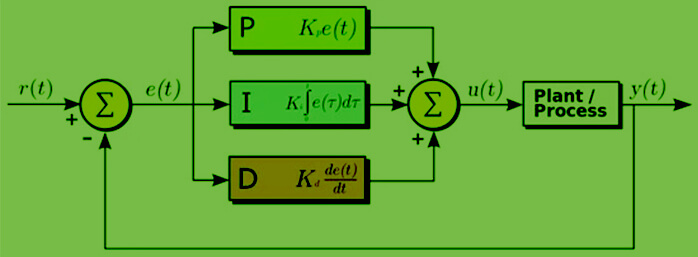
A Proportional-Integral-Derivative Controller regulates process variables such as temperature with precision and stability. It continuously monitors the current value of the variable and compares it to a desired setpoint. Based on the difference, known as the error, the controller calculates a correction that adjusts the system to reach and maintain the target value.
PID controllers integrate three control actions: Proportional (P), Integral (I), and Derivative (D). Each action serves a specific purpose in managing the system response.
Proportional (P) Action
The proportional term responds to the current error. The larger the deviation from the setpoint, the stronger the corrective output. For example, in a heating system, if the temperature is far below the setpoint, the controller increases power proportionally. While proportional control accelerates the response, it cannot fully eliminate the small residual error, called the steady-state offset.
Integral (I) Action
The integral term accumulates past errors to eliminate any remaining offset. By summing the error over time, it adjusts the output to ensure the process variable eventually matches the setpoint. For instance, if a system consistently stays below the target temperature, the integral component gradually boosts the corrective output until the target is achieved.
Derivative (D) Action
The derivative term predicts future error by evaluating the rate of change. It dampens system response to prevent overshooting the setpoint. If the temperature rises too quickly, derivative control reduces power preemptively, smoothing transitions and minimizing oscillations.
PID in Action
The combined PID response balances speed, accuracy, and stability. Proportional action reacts immediately to error, integral action corrects accumulated deviations, and derivative action anticipates future changes. Together, they provide seamless control, keeping the process variable close to the setpoint under changing conditions or disturbances.
What are the Different Types of Temperature Control Devices?
There are three types of temperature controllers: binary (on/off), proportional, and PID controllers. The choice of controller depends on the system requirements and the level of precision needed.
1. Binary or On/Off Controllers
Binary controllers operate with a simple principle: the output is either fully active or completely off. When the measured temperature deviates from the desired setpoint, the device toggles its output to correct the variation. This type of controller is often used in ovens, water heaters, or refrigeration units. Specialized variants, such as limit controllers, provide additional safety by halting operations once a critical threshold is reached.
2. Proportional Controllers
Proportional controllers introduce a more refined approach by continuously adjusting the output relative to the difference between the measured temperature and the setpoint. Instead of abrupt on/off cycles, these controllers gradually reduce energy as the temperature nears the target, minimizing overshoot and maintaining stable operation. Time-based proportional control can further refine heating or cooling, especially in sensitive applications like incubators or laboratory equipment.
3. Advanced PID Controllers
PID controllers combine proportional, integral, and derivative actions to achieve precise and dynamic control. The proportional term corrects present errors, the integral term compensates for accumulated past errors, and the derivative term predicts future deviations. This three-pronged approach allows the controller to adapt to disturbances, varying loads, or environmental changes automatically. Industries such as pharmaceuticals, plastics, and thermal processing rely heavily on PID controllers for consistent quality and operational efficiency.
Why PID Tuning Matters?
Proportional-Integral-Derivative Controller perform best when tuned to the system’s specific behavior. Proper tuning focuses on three goals:
- Minimizing Overshoot: Prevents the process from exceeding the setpoint.
- Reducing Settling Time: Brings the process variable to the target quickly.
- Maintaining Stability: Avoids oscillations or constant fluctuations.
Technicians adjust proportional, integral, and derivative gains incrementally, often starting with conservative values. Auto-tuning features can help, but skilled fine-tuning ensures precise control. Properly tuned PID controllers improve efficiency, protect equipment, and maintain consistent process quality.
Applications of PID Controllers
PID controllers are widely used in industries where precise and accurate control of process variables is essential. By continuously monitoring and adjusting system outputs, they ensure efficiency, consistency, and product quality while reducing waste and energy costs.
Key industrial applications include:
- Food and Beverage Processing: Maintaining consistent temperatures in ovens, cooking equipment, brewing systems, and fermentation tanks to improve product quality and reduce spoilage.
- Brewing Facilities: Controlling fermentation and mash temperatures to achieve uniform flavor profiles and production consistency.
- Chemical Manufacturing: Regulating reaction temperatures, pressures, and flow rates in chemical reactors and process vessels to maintain safety and operational precision.
- Pharmaceutical Production: Ensuring stable conditions during formulation, reaction, and storage processes to meet strict quality standards.
- Plastics and Extrusion Processes: Managing temperature and flow in extrusion lines to maintain product integrity and minimize defects.
Read more: How Temperature Controllers Enhance Industrial Automation
Why Choose GIC’s PID Controllers?
GIC temperature controllers are built for industries that demand accuracy, dependability, and real-time monitoring. With universal compatibility and advanced safety features, they ensure optimal process control and equipment protection.
Key Features
- Accuracy in Complex Procedures – High-performance control ensures process integrity in critical applications.
- Rapid Setup: Multiple device programming with memory card support
- Configurable Universal Input & Output – Supports RTDs, thermocouples, analog inputs, and multiple output options (Relay, SSR, Analog).
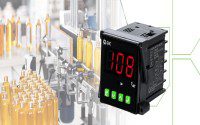
- Dual LED Display – 4-digit dual display shows set and actual values simultaneously for real-time clarity.
- Smart Alarm System – Built-in alarms for sensor break, loop break, band, and deviation to safeguard processes and equipment.
- Ramp & Soak Programmability – Up to 8 programmable steps for precise heating or cooling in delicate processes.
- Multiple Size Options – Available in 48×48 TC, 72×72 TC , and 96×96 TC models for versatile industrial integration.
Conclusion
PID controllers are the backbone of modern industrial automation, providing the precision, stability, and efficiency that complex processes demand. By continuously monitoring and adjusting system outputs, they prevent deviations, reduce energy waste, and maintain consistent quality across diverse industries. From simple on/off controllers to advanced PID systems, the right controller ensures reliable performance and safeguards critical equipment.
GIC’s PID controllers combine advanced functionality, versatile compatibility, and robust safety features, making them an ideal choice for industries that require precise control and operational excellence. Investing in a high-quality PID controller is not just about automation—it’s about achieving consistent results, optimizing efficiency, and protecting your processes for the long term.