Process monitoring in EV battery production means watching temperature, moisture, voltage and other line conditions all the time, so a deviation is caught while it is still small and not after it has become scrap, a recall or a safety problem. Monitoring Devices help track these critical parameters and identify deviations early.
Electric cars now take a growing share of new car sales worldwide, according to the IEA, and each one carries a battery that had to be built right from the start. That is hard to do. McKinsey points out that scrap in a new plant's early months can run extremely high. If a drying oven drifts, the air turns damp or the supply voltage dips, the problem can travel through a batch before anyone notices. An industrial monitoring system, supported by reliable Monitoring Devices, is there to catch that moment.
In this blog, you will get to know why process monitoring in EV battery production matters, where it counts most, what an industrial monitoring system covers, and which Monitoring Devices help.
Why does process monitoring matter in EV Battery Production?
It matters because a battery cell's quality is set on the production line, and a fault introduced there is usually hard to find later.
McKinsey calls yield and scrap rates the big swing factors in a battery factory's profit, and it sets tough yield and overall equipment effectiveness (OEE) targets for the ramp-up period. The tools it lists include real-time line monitoring, in-line metrology, manufacturing execution systems and statistical process control, applied at steps like slurry preparation, calendaring and electrolyte filling. Prices add pressure. McKinsey reports that pack prices have fallen to record lows and margins are tightening, so a plant has little room to waste material.
Process monitoring EV Battery Production: Where it matters most
Monitoring matters most where a small deviation is hard to spot later.
- Electrode coating and drying
Fraunhofer IKTS describes how in-line measurement of coating thickness and uniformity, using optical inspection and laser scanning, finds defects early and cuts scrap. Once coated, the electrodes go through drying ovens, and the oven temperature has to stay inside the limits of the recipe.
- Moisture control
Researchers writing in Monatshefte für Chemie found that the most common electrolyte salt breaks down quickly when water is present. It forms hydrofluoric acid, which attacks electrodes and separators and can end in short circuits. That is why moisture has to be kept out all the way through manufacturing. - Cell assembly and testing
Consumer Reports reported that the Chevrolet Bolt fires were traced to a torn anode tab and a folded separator inside the same cell, and LG said both were made during module manufacturing. A small flaw on the line became a safety issue for drivers.
What does an industrial monitoring system cover in a battery plant?
An industrial monitoring system gathers readings from sensors, meters and relays around the plant, shows them to operators and sounds an alarm when a value leaves its limit.
In a battery plant that usually means:
- Temperature in drying ovens and process chambers
- Voltage and phase conditions on the supply to critical equipment
- Fault signals from machines and utilities, gathered on a single panel
- Process values shown clearly to operators
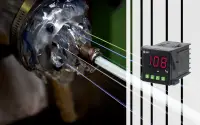
The system works in layers. Specialised in-line sensors, like the confocal sensors Fraunhofer IKTS describes, check the product itself. Monitoring Devices at panel level watch the equipment and utilities behind it. You need both for good process monitoring in EV battery production.
Which monitoring devices support battery production lines?
Monitoring Devices at panel and machine level keep production equipment inside its limits. Which ones suit a given line depends on its equipment and specifications.
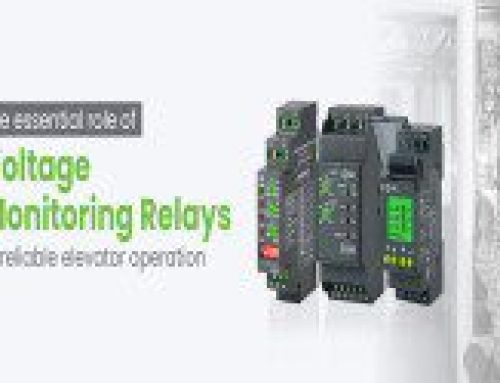
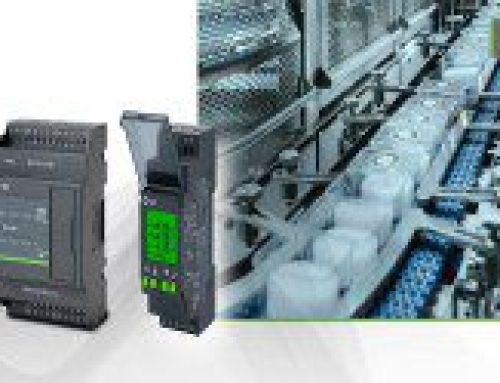
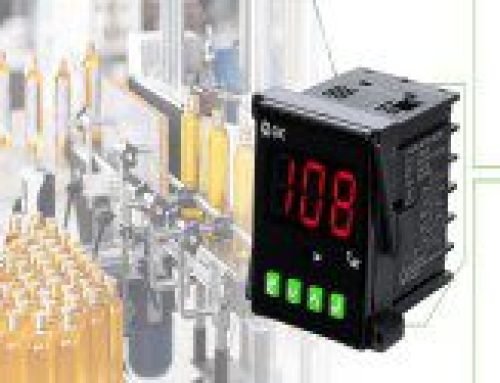
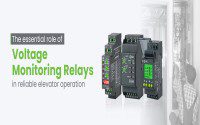
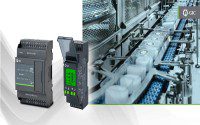
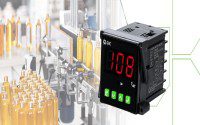
For oven and chamber temperature, a PID temperature controller or digital temperature controller works inside an industrial temperature control system. On the electrical side, a voltage monitoring relay, phase failure relay, phase sequence indicator or voltage phase monitor guards equipment against supply faults, and an energy monitoring device tracks how much power it uses. When something fails, an alarm annunciator panel brings the signals together as an industrial alarm system or fault annunciator system, so operators can see what failed and where. A digital process meter or process indicator panel shows measured values, while a production counter device and digital hour meter keep track of output and running time. The control panel itself runs on an SMPS power supply, for example an industrial power supply 24V unit or a DIN rail SMPS. Control logic comes from industrial PLC automation, operators get their view through an industrial HMI display, and an industrial communication converter or Modbus gateway lets devices with different communication standards talk to each other.
GIC offers these categories as part of its range for process control and industrial automation.
Why does this matter for India's battery industry?
India is still building its battery manufacturing capacity. IMARC Engineering, citing the Ministry of Heavy Industries, reports that the capacity awarded under the ACC PLI scheme is far bigger than what has been set up so far, and it cites a projection of sharp growth in India's battery demand.
New plants have to get through the ramp-up, and McKinsey warns that slow progress on OEE and stable quality hurts a producer's ability to compete. Real-time monitoring is on McKinsey's list of tools for that, so an industrial monitoring system installed from commissioning helps teams act early.
Safety belongs in this conversation too. After a run of electric two-wheeler fires, the road transport ministry formed an expert committee. The Hindustan Times reports that it found cells with no venting mechanism, faults in battery management systems, and problems in how cells were assembled into packs. People died and manufacturers recalled vehicles. Those are design and assembly findings, but they show why checks matter at every level, from cell to pack to factory.
Conclusion
Process monitoring in EV battery production protects yield, quality and safety by catching problems in temperature, moisture and electrical supply before they spread through a batch.
A well-planned industrial monitoring system, built on in-line measurement and dependable Monitoring Devices, gives plant teams the visibility to act early. As India builds its battery manufacturing base, GIC's range of controllers, relays, annunciators, indicators, power supplies, PLCs and HMIs can support the panel-level layer of that system.