As with every technology, devices must be scalable or designed for specific applications: small-scale, medium-scale, and large-scale operations. Programmable Logic Controllers (PLCs) have evolved to meet these diverse industrial requirements, providing cost-efficient solutions while fulfilling industry-specific needs.
Modern PLCs are classified based on architecture, I/O capacity, performance, and functionality. Manufacturers often combine characteristics, creating hybrid PLCs that serve specialized industrial applications such as automotive assembly, chemical processing, food packaging, and robotics automation.
In this blog, you will learn about the types of PLCs based on hardware size, input/output capacity, power supply, and specialized functionality, helping you choose the right programmable controller for your industrial application.
TL;DR
-
PLCs come in two main types, compact and modular, each offering different levels of scalability and configuration flexibility.
-
Output types like relay, transistor, triac, and analog support different industrial loads and switching needs.
-
PLCs vary by size and power options, from nano to safety PLCs, allowing industries to choose controllers based on complexity, safety, and I/O requirements.
The Two Major Types of PLC
The two primary types of PLC are:
- Compact (Fixed / Integrated) PLCs
- Modular PLCs.
Each type offers distinct advantages in scalability, I/O configuration, and system management.
Compact PLC (Fixed / Integrated)
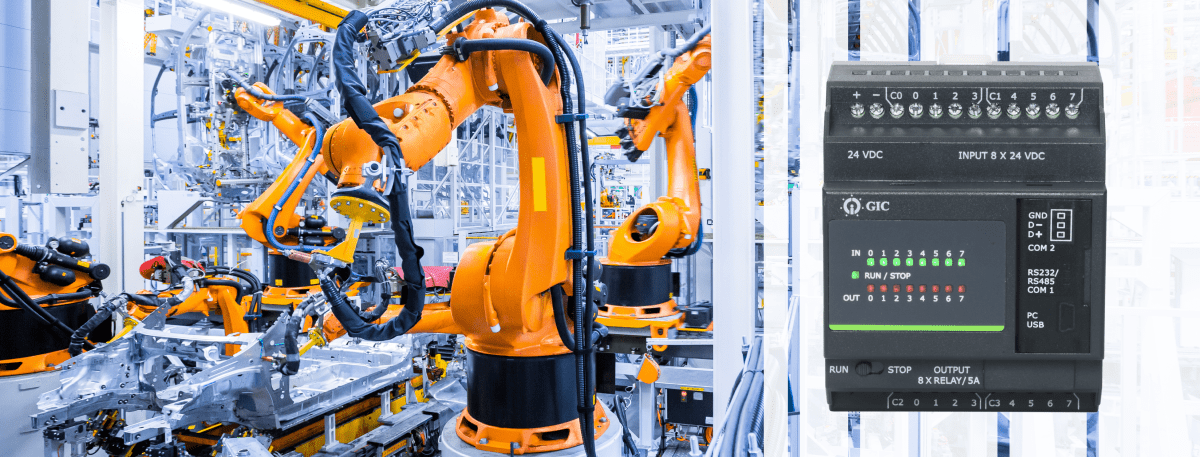
Compact PLCs, also called fixed I/O PLCs, integrate the CPU, power supply, and input/output modules into a single unit. This design simplifies installation and is ideal for small to medium-sized industrial processes.
- I/O Configuration: Inputs and outputs are embedded in the PLC itself and cannot be expanded. The number of I/O points is fixed and determined by the manufacturer.
- Programming: Compact PLCs include built-in programming capabilities, enabling operators to develop and adjust control algorithms for conveyor systems, robotic arms, or motor operations.
- Processing: Modern compact PLCs are equipped with processors capable of executing timed sequences, interlocks, and control logic for diverse tasks.
- Applications: Used in laboratory automation, packaging lines, small assembly systems, and conveyor operations.
Read more: Top 5 Most Popular PLC Programming Languages Explained
Advantages:
- Cost-effective solution for smaller setups.
- Simplified wiring reduces installation complexity.
- Low maintenance due to integrated design.
- Space-efficient for compact industrial layouts.
Modular PLC
Modular PLCs separate the CPU, power supply, and I/O modules into individual units mounted on a base or rack. This allows flexibility, scalability, and advanced customization for industrial systems with higher complexity.
- I/O Configuration: Modules can be added or removed, allowing the PLC to handle a larger number of sensors, actuators, and devices.
- Programming Flexibility: Supports multiple programming languages, allowing complex logic routines, process control, and data communication across different industrial subsystems.
- Processing: Modular PLCs can process high-volume inputs and outputs, integrate multiple subsystems, and manage extensive production lines.
Applications: Used in automotive assembly, chemical plants, food processing lines, robotics, and large-scale manufacturing facilities.
Advantages:
- High scalability for expanding operations.
- Fault detection is easier because each module is independent.
- Reduced downtime due to modular repair and backup modules.
- Memory expansion allows data-intensive processing.
- Module combinations enable customized solutions for complex industrial tasks.
Types of PLCs Based on Output
PLCs are classified according to their outputs as Relay, Transistor (DC), Triac (AC), and Analog outputs. Each output type has unique advantages and applications in industrial automation.
Relay Output Modules
Relay outputs were the earliest form of PLC-controlled outputs. They rely on electromechanical switches where the PLC sends current through a relay coil to create a magnetic field, which moves contacts to switch the load.
Applications: Suitable for AC and DC devices, including motors, pumps, solenoids, and lamps.
Advantages:
- Can handle high current loads without damaging the PLC CPU.
- Provides electrical isolation between the PLC and the controlled device.
Limitations:
- Mechanical wear reduces reliability during frequent switching.
- Slower switching speed compared to solid-state alternatives.
Read more: The History of PLCs
Transistor Output Modules
Transistor outputs are solid-state devices that use semiconductors to switch DC loads. They do not involve moving parts, allowing for high-speed switching.
Applications: Commonly used in conveyor systems, DC motors, sensors, and LED indicators.
Advantages:
- Faster switching than relay outputs.
- Durable, with no mechanical wear.
- Optoisolated design protects the PLC CPU from the output electrical source.
Limitations:
- Only compatible with DC devices.
- Typically limited to low-current applications.
Triac Output Modules
Triac outputs are solid-state AC switches. They act as two mirrored transistors, allowing current to flow in both directions.
Applications: Ideal for AC devices such as motors, heaters, and lighting systems.
Advantages:
- Faster than relay outputs for AC loads.
- Compact design reduces control panel space.
Limitations:
- Not suitable for very high-power AC devices.
- Requires careful consideration of load type (inductive vs resistive).
Analog Output Modules
Analog outputs are designed for continuous control, unlike digital outputs that operate ON/OFF. They control parameters such as motor speed, valve position, and turbine flow.
Applications: Variable speed motors, pumps, and industrial process control.
Advantages:
- Allows fine control over device operation.
- Supports voltage/current ranges specific to the output module and manufacturer.
Limitations:
- More complex circuitry compared to digital outputs.
- May require calibration for accurate control.
Types of PLCs According to Size
Mini PLC
Mini PLCs typically provide 128 to 512 input/output (I/O) points, making them ideal for small-to-medium scale automation systems.
Applications: Small manufacturing lines, light automation tasks, facilities expected to expand moderately.
Advantages:
- High I/O capacity without the bulk of larger PLCs.
- Cost-effective for small control systems.
- Simplified installation compared to larger systems.
Read more: Can PLC run without SCADA?
Micro PLC
Micro PLCs are compact devices with 15 to 128 I/O points, suitable for localized or very small automation setups.
Applications: Amusement rides, small machinery, isolated control systems requiring proximity.
Advantages:
- Installation near controlled devices reduces the need for a central PLC.
- Supports essential automation functions without excess capacity.
- Low cost and compact design for limited space.
Pico / Nano PLC
Pico and Nano PLCs provide fewer than 15 I/O points and are designed for learning, training, or ultra-small automation tasks.
Applications: PLC training kits, hobby projects, simple device controls.
Advantages:
- Extremely compact, often hand-sized.
- User-friendly for beginners, often with built-in display panels.
- Ideal for systems where only minimal control is needed.
Safety PLC
Safety PLCs are specialized programmable control systems designed to meet IEC 61508 functional safety standards.
Applications: Industrial processes where failures could cause harm or damage.
Features:
- Redundant circuits to ensure safe operation in case of failure.
- Functions like standard PLCs but with high reliability.
Considerations:
- Requires trained personnel for maintenance and monitoring.
- Higher cost due to added safety features.
Types of PLC Based on Power Supply
Programmable Logic Controllers (PLC control systems) can be classified by their power supply configuration. This classification affects installation, efficiency, and suitability for specific industrial applications.
Built-in Power Supply PLCs
Built-in power supply PLCs integrate a power unit within the PLC housing. These systems include a transformer and rectifier to convert incoming AC or DC power into the voltages required by the internal circuits.
Advantages:
- Reduced wiring and space requirements.
- Simplified installation for compact machinery or control panels.
- Fewer components that could fail, increasing reliability.
Applications:
- Small to medium-sized industrial equipment.
- Control systems where available space is limited.
- Systems that require consistent internal DC voltage (typically DC24V or DC48V).
External Power Supply PLCs
External power supply PLCs rely on a separate power source connected through input terminals. The external supply provides the necessary voltage and current for PLC components.
Advantages:
- Supports high-power applications beyond the capability of built-in units.
- Allows integration with backup power systems or UPS for critical industrial processes.
- Flexible for modular and scalable PLC control systems.
Applications:
- Large industrial automation systems with high I/O demands.
- Processes requiring continuous operation with redundant power.
- Systems where PLC expansion or multiple modules demand higher power input.
PLCs will continue driving industrial automation through IoT integration, smart control, and predictive maintenance. New technologies like Programmable Automation Controllers (PACs) and industrial embedded hardware expand functionality, while software like Ignition enhances monitoring, data collection, and process efficiency.
Despite innovations, PLCs remain popular for their simplicity, reliability, and affordability, maintaining a key role in Industry 4.0 manufacturing and operations.
Read more: Essential Components of PLCs Explained
Conclusion
Programmable Logic Controllers or PLC control systems are essential for automating industrial processes. Different types of PLCs allow engineers to choose the most suitable system for each application. Structural classifications such as compact and modular PLCs determine installation, scalability, and maintenance.
Output types including relay, transistor, triac, and analog define switching speed and compatibility with various devices. Size-based PLCs, from pico and nano to micro, mini, and safety PLCs, provide solutions for both small and critical control systems.
Understanding these classifications helps in selecting a PLC control system that balances cost, performance, scalability, and safety for effective automation.