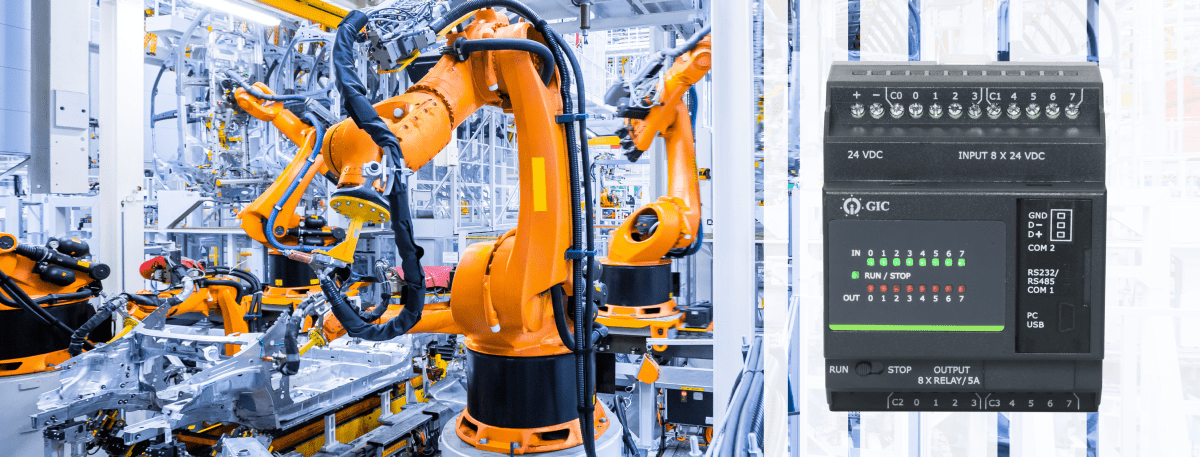
Programmable Logic Controllers (PLCs) have transformed industrial automation over the past six decades. Originally developed by Richard Morley at General Motors in 1968 to replace cumbersome relay banks, PLCs evolved into sophisticated industrial computers.
Understanding the history of PLCs reveals how factories shifted from manual relay-based control to highly automated, data-driven operations. In this article, you will learn about the brief history of programmable logic controllers.
TL;DR
-
PLCs began in 1968 as relay replacements and evolved through six generations into fast, networked, and highly reliable industrial controllers.
-
Major advancements included modular designs, standardized languages, HMIs, Ethernet networking, cloud connectivity, and now AI and edge computing.
-
Today’s PLCs and PACs blend together, offering smart automation, real time data processing, and secure communication for modern manufacturing.
What is the history of PLC?
The first programmable logic controller (PLC) was developed in 1968 at General Motors (GM). Engineers created the Standard Machine Controller to replace costly relay-based systems. Richard E. Morley, with Bedford Associates, designed the Modular Digital Controller, featuring solid-state components, modular expandability, and memory retention during power outages. Testing showed a 60% reduction in downtime, demonstrating its efficiency.
Read more: Top 5 Most Popular PLC Programming Languages Explained
Commercialization and Innovation
Bedford Associates became Modicon PLC, producing the Modicon 084, the first commercially successful PLC. Morley introduced Ladder Logic, a graphic representation of Boolean logic, making programming accessible to plant engineers. By the late 1970s, competitors like Allen-Bradley launched rival systems. Innovations such as Modbus, Data Highway, and programming terminals enabled PLC networking, remote logic entry, and digital program management, establishing PLCs as the foundation of modern industrial automation.
First Generation PLCs (1969–1970s)
The first-generation PLCs emerged in the 1970s to replace large, cumbersome relay-based control systems in industrial automation. These systems were primarily designed using custom logic circuits and could only be programmed with proprietary software. Memory and processing power were extremely limited, which constrained their capabilities. Despite these limitations, first-generation PLCs marked a significant step forward in reliability, allowing factories to reduce downtime and improve efficiency compared to relay-controlled machinery.
The Modicon 084 was a breakthrough in industrial automation, featuring:
- Modular Design: Allowed for scalability and customization.
- Ladder Logic Programming: Modeled after relay logic diagrams, making it intuitive for engineers transitioning from manual systems.
- Solid-State Components: Replaced mechanical relays, enhancing reliability and reducing maintenance needs.
Second Generation PLCs (1980s)
As industries embraced automation, the 1980s saw significant advancements in PLC technology. Manufacturers began integrating more powerful microprocessors and expanding memory capacities, enabling PLCs to handle more complex tasks and larger systems.
Key developments included:
- Standardized Programming Languages: Adoption of IEC 61131-3 standards brought uniformity to PLC programming, facilitating easier integration and maintenance.
- Enhanced Communication Protocols: Introduction of protocols like Modbus and Profibus allowed PLCs to communicate with other devices and systems, paving the way for networked automation.
- Improved User Interfaces: The development of Human-Machine Interfaces (HMIs) provided operators with graphical representations of processes, improving monitoring and control.
Read more: Essential Components of PLCs Explained
Third Generation PLCs (1990s)
The 1990s ushered in a new era for PLCs, characterized by further miniaturization and increased processing power. PLCs became more compact and capable of handling complex control tasks across diverse industries.
Notable advancements included:
- Increased Integration: PLCs began incorporating additional functionalities such as motion control and data acquisition, reducing the need for separate control systems.
- Advanced Networking Capabilities: Ethernet and other high-speed communication interfaces enabled real-time data exchange between PLCs and enterprise systems, supporting the rise of smart manufacturing.
- Enhanced Diagnostics: Built-in diagnostic tools allowed for proactive maintenance and quicker troubleshooting, minimizing downtime.
Fourth Generation PLCs (2000s)
The turn of the millennium brought about significant technological strides in PLC design and functionality. Fourth-generation PLCs were more powerful, flexible, and capable of integrating with emerging technologies.
Key features included:
- High-Speed Processing: Faster CPUs enabled PLCs to manage more complex algorithms and control processes in real-time.
- Expanded Memory: Increased memory capacities supported larger programs and more extensive data logging.
- Advanced Communication Protocols: Support for industrial Ethernet, wireless communication, and fieldbus systems facilitated seamless integration into diverse automation networks.
- Enhanced Security Features: Implementation of cybersecurity measures protected against unauthorized access and cyber threats.
Fifth Generation PLCs (2010s)
The 2010s saw PLCs evolve to meet the challenges of Industry 4.0, characterized by the integration of cyber-physical systems, the Internet of Things (IoT), and big data analytics.
Innovations during this period included:
- Cloud Connectivity: PLCs could now interface with cloud platforms, enabling remote monitoring, data storage, and analytics.
- Advanced Data Processing: Built-in capabilities for processing large volumes of data allowed for real-time decision-making and predictive maintenance.
- Enhanced User Interfaces: Touchscreen HMIs and mobile applications provided operators with intuitive control and monitoring options.
- Modular Design: Flexible, modular architectures allowed for easy scalability and customization to meet specific application needs.
Sixth Generation PLCs (2020s and Beyond)
The current generation of PLCs continues to push the boundaries of industrial automation, incorporating cutting-edge technologies to meet the demands of modern manufacturing.
Key characteristics include:
- Artificial Intelligence and Machine Learning: Integration of AI/ML algorithms enables predictive analytics, anomaly detection, and autonomous decision-making.
- Edge Computing: Local data processing reduces latency and bandwidth requirements, facilitating real-time control and analysis.
- Enhanced Cybersecurity: Advanced encryption and authentication protocols ensure the integrity and security of industrial networks.
- Sustainability Features: Energy-efficient designs and support for renewable energy sources contribute to environmentally friendly operations.
Key Milestones in PLC History
- 1968 – First PLC: General Motors developed the GM50 to replace relay-based systems; Morley’s Modular Digital Controller reduced downtime by 60%.
- 1969 – Modicon 084: Bedford Associates launched the first commercial PLC; ladder logic made programming easier for engineers.
- 1970s – Industry Adoption: PLCs replaced relay controls in factories; early models allowed modular expansion for inputs, outputs, and memory.
- 1982 – IEC 61131-3 Standard: Introduced multiple PLC programming languages, ensuring software consistency and interoperability.
- 1980s – PC Integration: PLCs began interfacing with personal computers for programming and diagnostics.
- 1990s – Human-Machine Interfaces (HMIs): Enabled real-time monitoring, production tracking, and troubleshooting.
- 2000s – Ethernet & Networking: PLCs adopted industrial protocols, improving data exchange and enterprise integration.
- 2010s – Compact & IoT-Ready: Smaller, faster PLCs with cloud connectivity, remote monitoring, and enhanced security.
- Today – Smart Controllers: Sixth-generation PLCs integrate PAC features, AI, IIoT, and cybersecurity for connected factories.
PLCs and PACs: Converging Automation Technologies
PLCs and PACs have evolved to handle complex industrial tasks. PACs use PC-based processors, offering advanced programming flexibility, while modern PLCs increasingly adopt similar capabilities. Both support motion control, vision systems, and multiple communication protocols. Ladder logic remains popular, but PACs also allow structured text, function blocks, and sequential charts. Industrial Ethernet and IoT enable real-time monitoring, and rugged designs ensure reliability in harsh environments.
Read more: Can PLC run without SCADA?
Conclusion
The history of PLCs reflects six decades of continuous innovation in industrial automation. From Richard Morley’s Modular Digital Controller at General Motors to today’s AI- and IoT-enabled sixth-generation PLCs, these controllers have consistently improved efficiency, reliability, and flexibility on the factory floor. Understanding their evolution—from relay replacements to smart, connected systems—highlights the critical role PLCs play in modern manufacturing. The convergence of PLCs and PACs, along with advancements in networking, data processing, and cybersecurity, ensures that industrial automation will continue to evolve, becoming more intelligent and integrated than ever before.