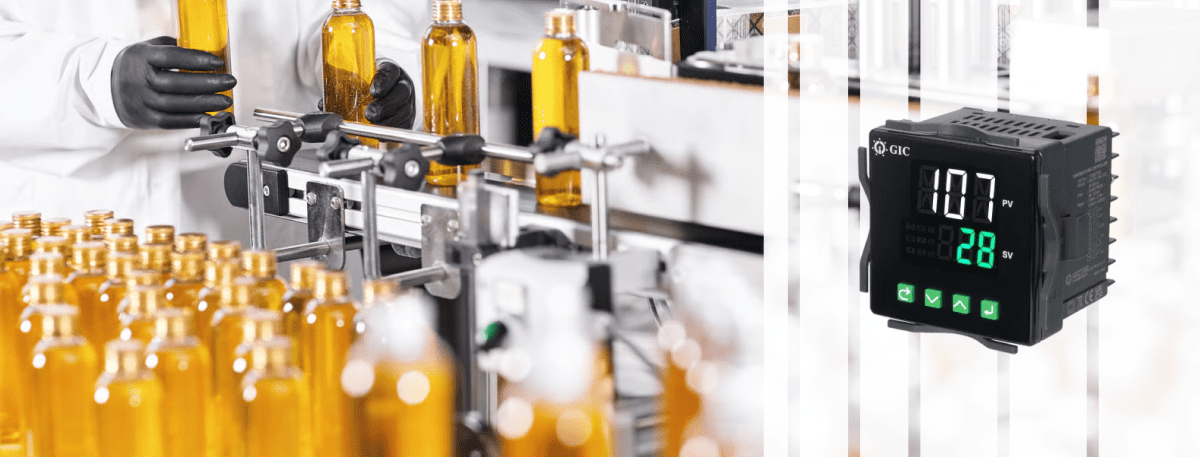
Industrial lines lose quality when temperature drifts from the required range. One small deviation disrupts food and beverage processing, weakens packaging seals, or changes melt flow in plastic extrusion. This single issue affects every stage of production.
Industrial temperature controllers solve this problem with accurate, real-time heat regulation. They keep each system within its target range, improve consistency, and reduce waste across food plants, packaging units, plastic molding machines, pharmaceutical chambers, furnaces, and industrial ovens. In this blog you will get to know where these controllers work best and how each application benefits from accurate thermal control.
TL;DR
-
Precise temperature control is critical across industries like food, packaging, plastics, pharma, furnaces, and industrial ovens to maintain product quality and reduce waste.
-
Industrial temperature controllers ensure stable heat conditions, which improves consistency, safety, and process reliability.
-
GIC PID controllers provide high accuracy, safety alarms, flexible inputs and outputs, and programmable control features for demanding industrial applications.
6 Key Applications of PID Temperature Controllers Across Major Industries
Food and Beverage Industry
Industrial temperature controllers support continuous food production by keeping baking systems, roasting units, fermentation rooms, pasteurization lines, and cold storage equipment within stable thermal conditions. They help plants maintain predictable product behavior at every stage of processing.
- Use Case: Stable heat ensures uniform baking, controlled fermentation activity, consistent roasting cycles, and safe pasteurization flow.
- Benefits:
- Strong microbial safety across batches
- Steady product texture and flavor
- Lower spoilage and waste
- Improved production consistency
Read more: How to Choose the Right Temperature Controller?
Packaging Industry
Packaging lines rely on precise temperature control in heat sealers, shrink tunnels, laminators, and thermoforming machines. A controller stabilizes the sealing point and ensures each material layer bonds with the proper strength.
- Use Case: The PID controller keeps sealing bands steady so films melt evenly and form reliable packaging joints during high speed cycles.
- Benefits:
- Stronger seals and better product protection
- Lower rework and waste
- Fewer machine stoppages
- Improved output quality across the line
Plastic Molding and Extrusion Machines
Plastic processors use temperature control device to regulate barrel zones, heater bands, dies, mold cavities, and cooling circuits. Controlled heat keeps the melt condition stable and prevents fluctuations that affect flow behavior.
- Use Case: The controller maintains a predictable melt profile so the material fills molds cleanly and moves through extrusion lines without variations.
- Benefits:
- Higher dimensional accuracy
- Smooth and consistent surface quality
- Reduced warpage and shrinkage issues
- Lower rejection rates and improved cycle performance
Pharmaceutical Industry
Pharmaceutical plants depend on precise temperature control in incubators, bioreactors, dryers, coating systems, and stability chambers. A controlled environment protects sensitive materials and ensures reliable test conditions.
- Use Case: The controller stabilizes chamber conditions so formulations, cultures, and coated products develop correctly without thermal drift affecting results.
- Benefits:
- Stronger batch reliability
- Accurate stability data
- Better compliance with regulatory standards
- Consistent product development outcomes
Read more: What is a PID Controller?
Furnaces
Industrial furnaces used for heat treatment, annealing, sintering, and hardening require tight thermal regulation. Temperature controllers keep heating cycles consistent and maintain uniform conditions inside the chamber.
- Use Case: The controller regulates furnace activity so metals receive the same thermal exposure during each stage of the treatment cycle.
- Benefits:
- Better material strength and durability
- More consistent structural properties
- Lower scrap and rework
- Higher process reliability
Industrial Ovens and Dryers
Industrial ovens and dryers depend on accurate heat control for curing, drying, baking, preheating, and moisture reduction. A digital temperature controller ensures uniform heating patterns and prevents hotspots.
- Use Case: The controller maintains a stable heating profile so materials cure evenly and moisture removal happens at the correct pace.
- Benefits:
- More uniform final results
- Reduced overheating and product damage
- Higher throughput with fewer interruption
- Improved quality across sensitive materials
Why Choose GIC PID Controllers?
GIC PID controllers serve industries that need precise control, dependable performance, and continuous real time monitoring. The system supports universal inputs, advanced safety functions, and flexible output options, which makes it suitable for complex industrial environments that cannot afford thermal errors.
Key Features
- High Accuracy for Critical Processes: Precise control logic maintains process integrity during demanding operations.
- Fast Configuration: Memory card support enables quick multi device programming and reduces setup time.
- Universal Input and Output Compatibility: Works with RTDs, thermocouples, analog inputs, and multiple output formats such as relay, SSR, and analog.
- Dual LED Display: A clear dual readout shows set values and actual values together for immediate visibility.
- Advanced Alarm Functions: Built in alarms for sensor break, loop break, band, and deviation help protect equipment and prevent process failures.
- Ramp and Soak Capability: Up to eight programmable steps support controlled heating or cooling sequences in sensitive applications.
- Multiple Size Variants: Available in 48×48 TC, 72×72 TC, and 96×96 TC formats to fit different panel layouts and machine requirements.
 info@gicindia.com