Inconsistent temperature can compromise product quality, increase energy costs, and even damage critical equipment. Industries like food processing, pharmaceuticals, plastics, and textiles rely heavily on precise thermal management to maintain efficiency and safety.
Choosing the wrong temperature control system can lead to process instability, costly downtime, and inefficiencies. With a wide variety of options, including PID controllers, relay-driven units, and SSR outputs, selecting the right one can be confusing without a clear understanding of your process needs.
Understanding controller types, universal inputs for thermocouples and RTDs, LED displays, auto-tuning features, alarm functionalities, and mounting RS485 Communications, Analog Input, Analog Output Options ensures reliable and accurate process control. This guide will help you identify the main features, compatibility, and specifications you need, so your operations stay consistent, safe, and energy efficient.
How To Choose the Right Temperature Controller?
To select the right temperature controller, first check the sensor type and the temperature range your process requires. Consider the control method, such as on/off or PID, and the output type, like relay, SSR, or analog. Evaluate communication options for system integration, the physical size, and environmental ratings like IP. Finally, ensure the controller matches your application, fits your budget, and comes with reliable manufacturer support.
Input Sensor and Temperature Range
- Sensor Type: Thermocouples provide fast response across a wide temperature range, making them suitable for furnaces or extrusion processes. RTDs deliver higher accuracy and stability for lower-temperature applications like food storage or laboratory experiments.
- Temperature Range Compliance: Verify that both the controller and sensor can handle the full operational spectrum. Exceeding these ranges may lead to inaccurate readings, device damage, or compromised process quality.
Read more: Understanding the Basics of Temperature Controllers
Control Methods
Temperature controllers offer multiple regulation strategies tailored to the complexity of the process:
- On/Off Control: Provides basic regulation by switching output devices fully on or off. Best for processes where minor fluctuations are acceptable.
- PID Control: Integrates proportional, integral, and derivative adjustments to maintain highly stable temperatures, critical in chemical reactions, curing processes, and precise manufacturing.
Read more: What is a PID controller?
Output Requirements
Controller outputs determine how devices such as heaters, chillers, or variable-speed drives respond:
- Electromechanical Relays: Provide simple on/off control for lower frequency applications.
- Solid State Relays (SSRs): Offer high-frequency switching, suitable for fast-cycling equipment.
- Analog Outputs: Enable proportional control for modulating devices like fans, pumps, or valves.
Environmental and Physical Considerations
Controllers often operate in challenging environments. Choose devices with appropriate IP to resist dust, moisture, oils, and temperature extremes. Physical dimensions and mounting options, including flush or panel mount, should align with available space and ensure adequate ventilation. Selecting robust controllers enhances longevity and reduces maintenance needs.
Advanced Features and Usability
Modern temperature indicators offer features that improve safety and efficiency:
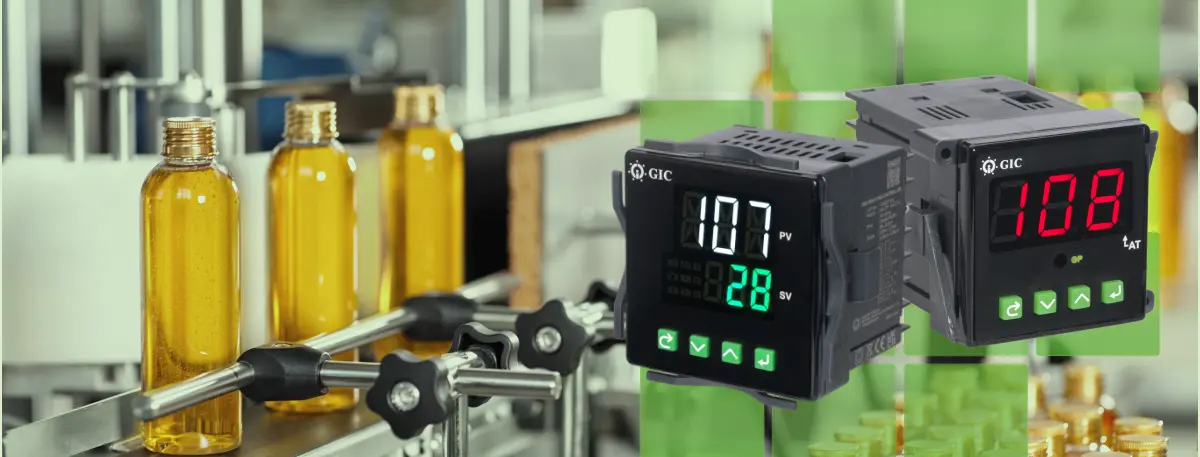
- Dual LED Displays: Show both setpoint and actual process temperature simultaneously for easy monitoring.
- Alarm Functions: Notify operators of deviations that could disrupt operations.
- Ramp-Soak Programming: Automates gradual heating and cooling cycles to prevent thermal shock in sensitive processes.
- Multiple Device Programming via SD Card: Ensures consistent configuration across several controllers, saving setup time and reducing errors.
Compliance and Standards
Always verify that controllers meet industry certifications like CE, UKCA, RoHS. Compliance ensures safety, regulatory adherence, and reliable performance, which is particularly important in highly regulated sectors like pharmaceuticals, food production, and chemical manufacturing.
Budget and ROI Considerations
While cost is important, prioritize controllers that deliver reliability, accuracy, and long-term durability. Investing in high-quality controllers reduces downtime, energy waste, and maintenance costs, providing a better return on investment over the device’s lifecycle.
Why Choose GIC PID Controllers?
For industries where precision and reliability make all the difference, GIC PID controllers deliver consistent performance. Designed to integrate seamlessly into diverse applications, they combine flexibility, advanced safeguards, and user-friendly monitoring to keep operations running smoothly.
Highlights at a Glance
- Precise Control for Demanding Tasks – Maintains stability and accuracy in sensitive industrial processes.
- Versatile Input & Output Options – Works with RTDs, thermocouples, analog input, and offers multiple output modes including Relay, SSR, and Analog.
- Clear Dual Display – Shows both set and process values simultaneously for instant visibility.
- Enhanced Safety Alerts – Built-in alarms detect sensor errors, loop failures, and deviations to protect both systems and equipment.
- Advanced Programmable Functions – Ramp and soak capability with up to 8 steps for controlled heating or cooling cycles.
- RS485 Communication – Enables seamless SCADA and PLC connectivity for remote monitoring.
- CT Input Compatibility – Supports precise current monitoring and protection of heating elements.
- Flexible Model Sizes – Offered in 48×48 TC , 72×72 TC, and 96×96 TC to fit varied panel requirements.
 info@gicindia.com