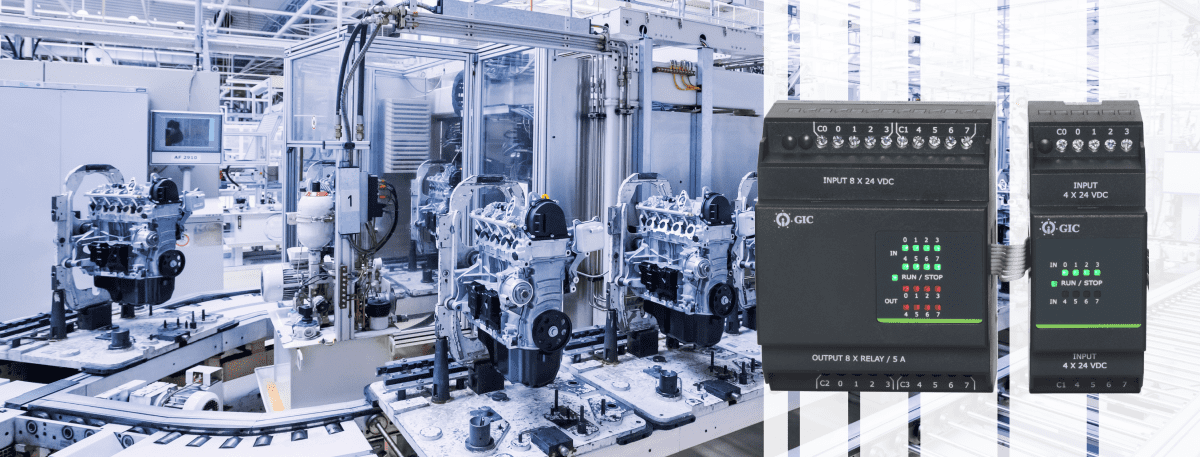
Automation relies on precise control devices to manage electrical circuits and industrial processes. Relays and Programmable Logic Controllers (PLCs) are two core components in this ecosystem, each designed for specific functions and operational scales.
A relay switches electrical signals directly, offering a simple and cost-effective solution for small circuits. In comparison, a PLC uses a central processing unit, input/output modules, and programmable logic to handle complex automation tasks, real-time monitoring, and large-scale industrial operations.
Examining these differences helps engineers and technicians select the right system for efficient, reliable, and scalable control. In this blog, you will learn what a relay is, what a PLC is, and understand the key differences between them.
TL;DR
-
Relays are simple electrical switches used for basic ON and OFF control, ideal for small circuits and low complexity applications.
-
PLCs are programmable digital controllers designed for complex automation, offering scalability, real time monitoring, diagnostics, and flexible control through software.
-
Choose relays for simple, low cost control systems and PLCs for advanced, scalable, and large scale industrial automation.
What is a Relay?
A relay is an electromechanical or solid-state switch that opens and closes electrical circuits based on an input signal, usually voltage or current. It allows low-power signals to control high-power circuits safely and efficiently.
Components of a Relay
- Coil: Generates a magnetic field when energized to actuate the switch.
- Contacts: Conduct current when the relay is activated (normally open or normally closed).
- Armature: Moves the contacts in response to the coil’s magnetic field.
- Spring: Returns the armature to its default position when the coil is de-energized.
Advantages of Relays
- Simple and cost-effective for basic circuit control.
- Can isolate control and power circuits for safety.
- Fast switching for low to medium-speed applications.
- Easy to maintain and replace.
Uses: Motor control, lighting systems, home automation, signal switching, and protection circuits.
What is a PLC (Programmable Logic Controller)?
A Programmable Logic Controller (PLC) is a digital industrial computer designed to control manufacturing processes, machinery, or automated systems. It executes programmable logic instructions to monitor inputs, control outputs, and perform real-time operations.
Components of a PLC
The main components of PLC are:
- CPU (Central Processing Unit): Executes logic instructions and manages system operations.
- Input Modules: Receive signals from sensors, switches, or other devices.
- Output Modules: Control actuators, motors, lights, or other equipment.
- Power Supply: Provides stable voltage to the PLC system.
- Programming Interface: Allows engineers to write, upload, and modify control programs.
Advantages of PLCs
- High flexibility for complex automation tasks.
- Real-time monitoring and control of industrial processes.
- Scalable for large systems with multiple inputs and outputs.
- Reduced wiring compared to traditional relay logic systems.
- Easy to modify or upgrade through software changes.
Uses: Assembly lines, robotics, conveyor systems, process control in industries
Read more: Top 5 Most Popular PLC Programming Languages Explained
What is the Difference between Relay and PLC?
PLCs and relays are essential control devices in industrial and electrical systems, but they differ significantly in function, complexity, and applications. Relays are simple switches ideal for basic electrical control, while PLCs are programmable digital devices designed for complex automation tasks. Understanding these differences helps engineers, technicians, and system designers select the right solution for efficiency, reliability, and scalability.
| Basis of Difference | Relay | Programmable Logic Controller (PLC) |
|---|---|---|
| Definition | An electrically operated switch used to turn ON/OFF a high-power circuit with a low-power signal. | A semiconductor-based switching device used to automatically control industrial processes. |
| Primary Function | Controls switching operations in a circuit. | Monitors and controls industrial processes and circuits. |
| Types | Electromagnetic relays, solid-state relays. | Compact PLC, modular PLC. |
| Construction | Electromagnet, armature, input terminals, control terminals (electromagnetic); semiconductor mechanism (solid-state). | Input module, processing unit, PLC program, power supply, output module. |
| Operation | Low-power input energizes coil, moving armature to switch the circuit. | Input from sensors triggers the CPU to process and send output through modules. |
| Nature of Operating Signal | Electrical signals | Digital signals. |
| Control System Name | Relay logic control / hard-wired control system. | Programmable logic control system. |
| Programming | Not required. | Required; uses industrial programming languages. |
| Modification in Circuit Design | Difficult to modify. | Easy to modify via software. |
| Memory | None. | Stores programs in memory modules. |
| Fault Determination | Difficult to detect faults. | Easy to identify faults using software diagnostics. |
| Flexibility | Low | High: supports complex operations and scalable systems. |
| Input/Output Capability | Limited I/O. | High I/O; supports multiple inputs and outputs. |
| Response Time | Around 10 ms or less. | Around 50 ms or more. |
| Advanced Functionality | Limited to basic switching; fault detection only. | Programmable for timers, counters, advanced logic, and automation tasks. |
| Applications | Motor control, lighting systems, traffic systems, power protection, home appliances, automotive systems. | Motor control, lighting, traffic systems, power protection, home appliances, automotive systems. | Automotive assembly lines (robots, conveyors, welding), food and beverage processing, chemical process control, textile automation, oil and gas operations, pharmaceutical manufacturing. |
Conclusion
Relays are simple switches that manage electrical circuits, while PLCs are programmable logical controllers designed for complex automation and process control. Understanding their roles, functions, and applications helps select the right system for efficient, reliable, and scalable industrial operations.
 info@gicindia.com