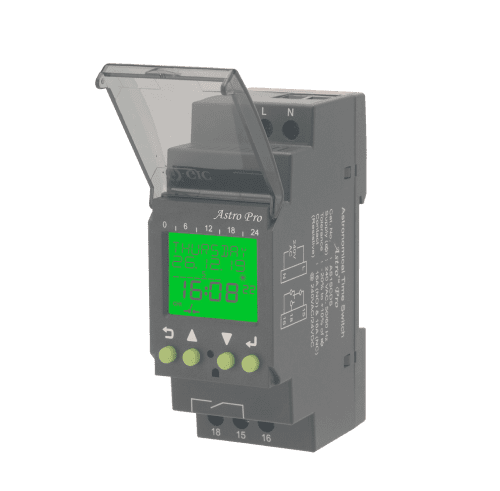
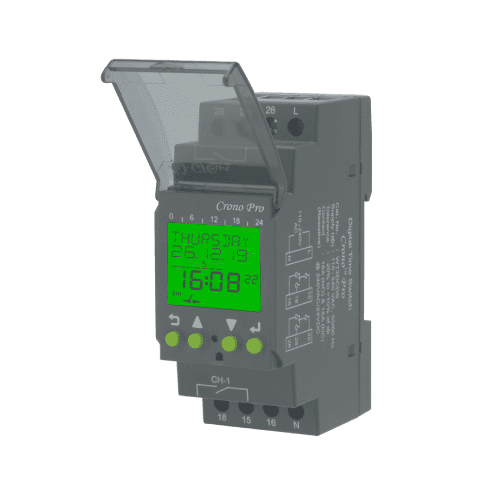
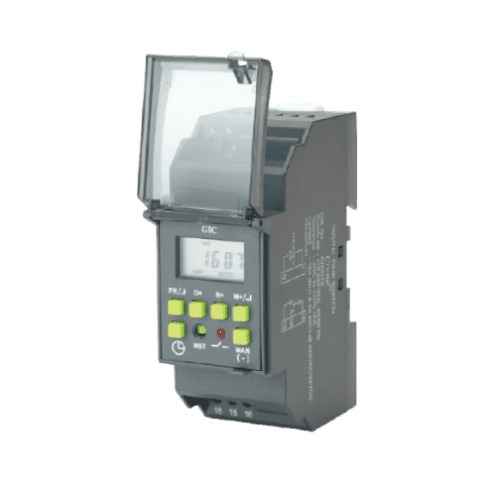
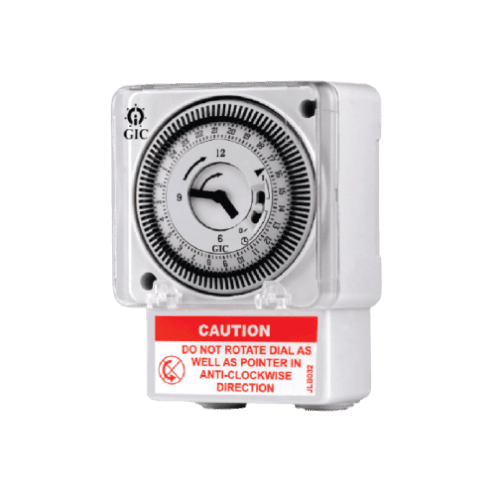
An Astronomical Time Switch is an advanced time-control device designed to switch electrical loads based on sunrise and sunset times for a given location. Unlike traditional time switches that rely on fixed schedules, astro time switches automatically adjust switching times throughout the year according to the natural day–night cycle. This makes them ideal for outdoor lighting, signage, and energy-saving applications, ensuring accurate and efficient automation without the need for manual adjustments.
Featured GIC Astronomical Time Switch Products
- ATS-500 – Daily astronomical switch with automatic sunrise/sunset calculation.
- ATS-600 – Weekly astronomical time switch supporting multiple ON/OFF cycles.
- ATS-700 Advanced – High-precision switch with LCD, GPS-based accuracy, and programmable offsets.
- Accessories – DIN-rail mounting bases, protective covers, and sockets for easy installation.
Key Benefits of Astronomical Twilight Switches
Automatic Adjustment
Eliminates the need for manual resetting, as switching times adapt automatically to seasonal sunrise and sunset variations.
Energy Efficiency
Ensures lights and equipment operate only when needed, significantly reducing energy consumption and operating costs.
Wide Application Range
Ideal for street lighting, signage, outdoor displays, and security lighting systems.
Reliability & Accuracy
GIC Astronomical Twilight Switches are engineered with precision timing algorithms and robust hardware for long-lasting, dependable performance.
Frequently Asked Questions – Astronomical Time Switch
Astronomical Time Switches are used to automatically control outdoor lighting and electrical loads by tracking sunrise and sunset times instead of fixed schedules.
- The user sets the geographic location and desired ON/OFF conditions.
- The switch calculates daily sunrise and sunset times for that location.
- Loads (e.g., lights) are switched ON at sunset and OFF at sunrise (or as per user-defined offsets).
GIC Astronomical Time Switches are commonly used in:
- Street and highway lighting
- Garden and landscape lighting
- Outdoor signage and hoardings
- Public spaces and building exteriors
- Security and perimeter lighting
- No seasonal manual adjustments required
- Higher energy savings and efficiency
- Accurate sunrise/sunset tracking for any location
- Flexible ON/OFF offsets for user preferences
Key considerations include:
- Daily or weekly scheduling requirements
- Location programming (latitude/longitude or GPS)
- Load switching capacity
- Display type (LCD/LED)
- Mounting options and durability