
Reliable Interface Relays for Secure Switching and Signal Isolation
GIC's Interface Module are designed to perform the essential function of separating control circuits from load circuits, ensuring secure signal switching and maintaining system integrity. These relays allow low-power signals from PLCs, sensors, or controllers to control high-power loads without compromising safety or stability.
High-performance in GIC Interface Module function as a critical interface module within industrial automation architectures, enabling safe signal transfer between PLCs, HMIs, SMPS units, sensors, and field devices. Acting as an interposing relay, each unit provides dependable switching and galvanic isolation between control circuits and load circuits. When deployed inside automation panels, GIC Interface relay module support stable signal conditioning, coordinated device communication, and scalable system design—making them well suited for high performance industrial control environments industrial automation panels require GIC Interface Relays due to their compatibility with both AC and DC power, compact DIN-rail-friendly design, and galvanic isolation. The plug-in structure facilitates quick replacements and minimizes downtime, which is crucial in high-throughput environments.
Supply Voltage +
Mode +
Mounting +
Relay +
No. Of Programs +
Display +
Power Reserve +
Clock Accuracy +
Pre-Programmed +
Accessories +
Product visibility +
Analog Input +
Base/Ext +
Bazel type +
Center Distance +
Clock +
Control Action +
Display with & without +
Input/Output +
No. of digits +
No. of set points +
Output +
Output 1 +
Output 2 +
Output 3 +
Product Type +
Read Out +
Register +
RS485 Communication +
Sensor Input +
Size +
Termination +
Contact +
Delay +
Enclosure Design +
Function +
Input Voltage +
Output Current +
Output Voltage +
Power +
Relay Output +
Supply +
Timing Range +
Variant +
Alarm Output +
Analog Output +
Auto Reset time +
Auxiliary Supply +
CBCT Size +
Colour +
Current Range +
Digital Display +
Digital Input +
Digital Output +
Display Colour +
High Speed Inputs +
Input Signal +
LCD Display +
Leakage Current +
Module +
Neutral Loss +
Output Signal +
Over Frequency +
Over Voltage +
Phase Asymmetry +
Phase Loss +
Phase Sequence +
Reset +
Sensor Supply +
Series +
Settable Off Delay +
Settable On Delay +
System +
Transistor Output +
Under Frequency +
Under Voltage +
Voltage +
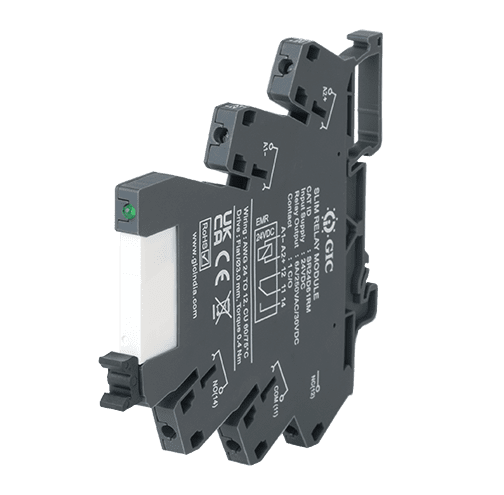
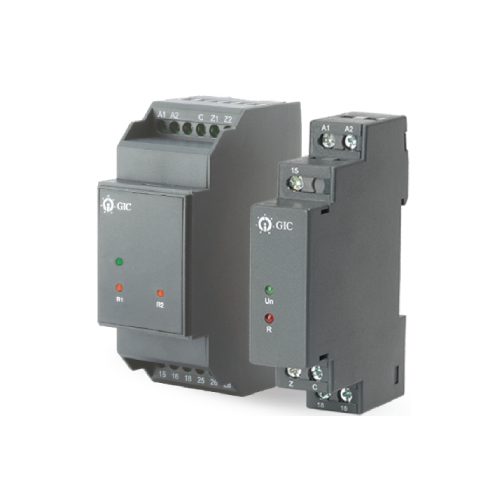
GIC Interface Relays function as a critical interface module within industrial automation architectures, enabling safe signal transfer between PLCs, HMIs, SMPS units, sensors, and field devices. Acting as an interposing relay, each unit provides dependable switching and galvanic isolation between control circuits and load circuits. When deployed inside automation panels, GIC Interface Relay Module support stable signal conditioning, coordinated device communication, and scalable system design—making them well suited for high performance industrial control environments.
Key Benefits of GIC interface Module
Safe Signal Conversion & Load Switching
High-power devices such as motors, lamps, or contactors can be safely operated by GIC Interface module, which use low-voltage signals from controllers, sensors, or PLCs. This approach enhances system safety by ensuring circuit protection at both the control and load ends.
Protecting Equipment with Electrical Isolation
These relays protect control circuits from electrical noise, electromagnetic interference, and voltage spikes by creating galvanic isolation between input and output. This enhances the lifespan of delicate electronics and minimizes system failures.
Compact, Panel-Friendly Design
Due to their DIN-rail mounting design, GIC relays are simple to install in panels with limited space. Their modular form factor makes them perfect for contemporary control environments because it allows for clean wiring layouts and rapid expansions.
Fast Maintenance & Broad Compatibility
Plug-in relay designs allow for quick replacements without rewiring. GIC Interface Relays are appropriate for a wide range of use cases across industries because they are available in AC and DC coil variants and support a wide voltage range.
Why choose GIC Interface Module?
GIC Interface module provide reliable signal switching and electrical isolation between control systems and field devices, enabling efficient operation. They provide dependable performance, simple installation, and long-term operational efficiency across a variety of applications including HVAC systems, lighting control, and process industries. They are perfect for industrial automation, machine control, and building management systems.
 info@gicindia.com