
Alarm Annunciators

Home » Alarm Annunciators
Alarm Annunciators2026-01-19T17:57:03+05:30

Alarm Annunciators

GIC has introduced Alarm Annunciators that come equipped with advanced features. As automation continues to increase at every stage of a process control system, they are crucial for immediately detecting faults and providing instant visual and audible alarms to safeguard valuable equipment. Regardless of the complexity of your alarm needs, offer the most cost-effective solution.

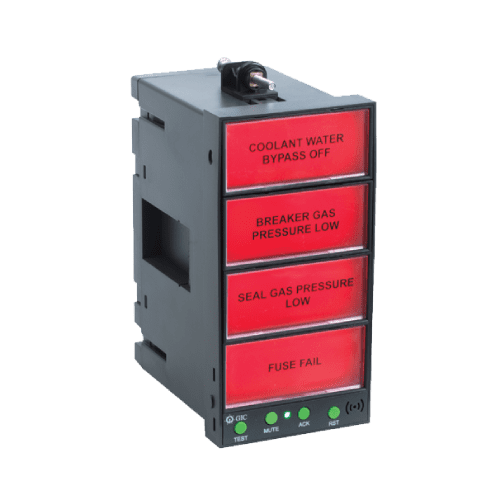
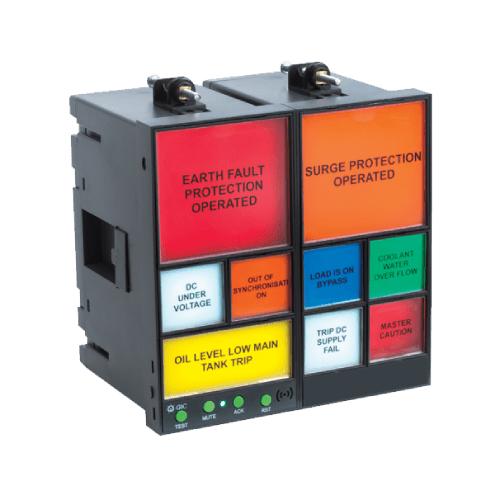
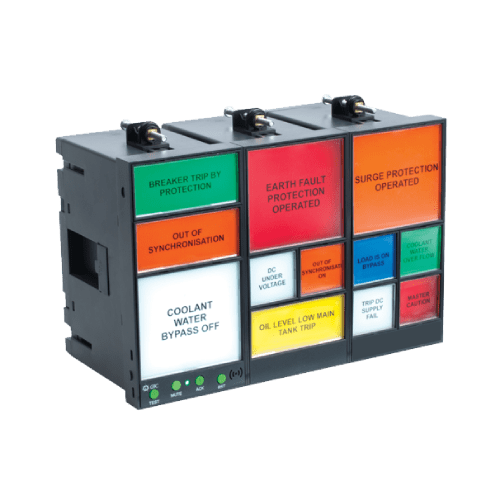
Annunciator Window is a group of indicator lights that use blinking LEDs and audible buzzers to signal the presence of abnormal conditions. In industrial process control, an annunciator panel is a system that alerts operators of alarm conditions in the plant. GIC provides a wide range of Alarm Annunciators, all designed to meet the needs of modern-day manufacturing plants and their future requirements.

GIC introduces Alarm Annunciators with the most advanced features. With increasing automation at every stage in a process control system, our Alarm Annunciators would play a vital role in immediate fault recognition by providing instant visual and audible alarms to protect valuable equipment. However simple or complex your alarm requirement is, our Alarm Annunciators will provide the most cost-effective solution.

Alarm Annunciator Panel is an array of indicator lights. It signals the presence of abnormal conditions by blinking an LED and sounding an audible buzzer. In industrial process control, an annunciator panel is a system to alert operators of alarm conditions in the plant. GIC offers a wide range of Alarm annunciator panel. The entire range is designed with an understanding of the modern-day manufacturing plant and its future requirement.

Configure your alarm annunciator
Category:

Description

Catalogue
Instruction Manual
CE & RoHS

GIC’s Annunciator Panel: Multi-Point Fault Detection with Instant Alerts and Total Control

The purpose of GIC’s alarm annunciator panel is to deliver industrial process monitoring systems with enhanced visibility and real-time fault notifications. With scalable configurations, rugged durability, and fully programmable alarm logic, these annunciators improve plant safety, streamline operator responsiveness, and reduce the risk of equipment downtime.

GIC’s annunciator windows provide precise fault detection across multiple input channels, generating clear visual and audible alerts for immediate operator action. Designed for demanding industrial environments, they offer reliable process display, consistent performance, and user-friendly operation.

Fully compatible with SMPS, monitoring relays, and Modbus communication modules, GIC annunciators integrate seamlessly into industrial automation systems. This integrated ecosystem ensures fast configuration, smooth interoperability, and dependable end-to-end alarm management across manufacturing plants, power generation facilities, water treatment plants, and other critical infrastructure.

Key Features & Benefits of GIC’s Annunciator Window

Multiple Point Fault Identification with real-time Alerts

Using buzzers, sirens, flashing lights, or LED windows, GIC annunciator window immediately alert users to issues by tracking multiple input signals. This quick and easy clear feedback ensures that operators act on the spot, reducing downtime and safeguarding vital assets.


Adjustable Alarm System

You can define standard or unique sequences (like ISA S18.1) using fully programmable logic. Adjust the acknowledge, reset, and escalation settings to suit the particular safety requirements and operational requirements of your plant.


Enhanced Efficiency of the Operator

A major benefit when conditions require immediate choices or high levels of pressure is that operators can rapidly identify the sources of faults without having to navigate complex HMI screens.


Easy to set up, accurate, and flexible

Modbus communication, remote I/O integration, and panel mounting are all supported by GIC annunciators, which come in configurations ranging from 2 to 48 channels.


Why Choose GIC Annunciator Panel?

GIC annunciator relay provide both visual and audible notifications for system faults, enhancing plant safety, simplifying troubleshooting, and minimizing downtime. Built for reliability and ease of use, these annunciators are ideal for power plants, substations, oil and gas facilities, manufacturing units, water treatment plants, HVAC systems, and transportation networks. With adjustable alarm sequences and multiple input channels, they are essential for critical infrastructure monitoring and control room operations.

GIC offers a complete range of annunciator window, designed to streamline industrial alerting systems, ensure accurate fault detection, and deliver dependable audio-visual alarm management for modern facilities.

Alarm Annunciators

configure Your alarm annunciator

Click here to apply change for all windows.
{{error_message}}

Your Alarm Annunciator (PART CODE NO: A{{powerSupply}}{{productSize}}D{{productSizes[0]==true?(productSizes[1]==true?(productSizes[2]==true?(productSizes[3]==true?(productSizes[4]==true?(productSizes[5]==true?(channels[0].length+channels[1].length+channels[2].length+channels[3].length+channels[4].length+channels[5].length):(channels[0].length+channels[1].length+channels[2].length+channels[3].length+channels[4].length)):(channels[0].length+channels[1].length+channels[2].length+channels[3].length)):(channels[0].length+channels[1].length+channels[2].length)):(channels[0].length+channels[1].length)):channels[0].length):''}}{{windowsizeTitle[selwindowsize]}}{{pushButtonPartCode}})

{{productSizes[0]==true?(productSizes[1]==true?(productSizes[2]==true?(productSizes[3]==true?(productSizes[4]==true?(productSizes[5]==true?(channels[0].length+channels[1].length+channels[2].length+channels[3].length+channels[4].length+channels[5].length):(channels[0].length+channels[1].length+channels[2].length+channels[3].length+channels[4].length)):(channels[0].length+channels[1].length+channels[2].length+channels[3].length)):(channels[0].length+channels[1].length+channels[2].length)):(channels[0].length+channels[1].length)):channels[0].length):''}} ALARM POINTS

{{caprow.value}}

{{caprow.value}}

{{caprow.value}}

{{caprow.value}}

{{caprow.value}}

{{caprow.value}}

PUSH BUTTON: SMALL BIG
{{pushButtonMessage}}
POWER SUPPLY:


{{powerSupplyMessage}}
FAULT INPUT VOLTAGE: INTERNAL (12V DC) / EXTERNAL (12V-270V AC/DC) POTENTIAL FREE
{{faultIPVoltageMessage}}
LED: NON-REPLACEABLE REPLACEABLE
{{replaceableLEDMessage}}
RESPONSE TIME: 100 ms(NORMAL) 10 ms(FAST) 40 ms
MANNED/UNMANNED FEATURE: NO YES

What is Alarm Annunciator?

An alarm annunciator, also known as an annunciator panel, is a crucial component in industrial control systems. It is designed to provide visual and audible alerts to operators, indicating the status of various alarm conditions in a process or facility. The alarm annunciator acts as a centralized monitoring system, displaying alarms in a clear and concise manner, and ensuring timely responses to critical events.

An alarm annunciator consists of multiple alarm channels, each representing a specific alarm point or event. When an alarm condition is triggered, such as equipment failure, abnormal process parameter, or safety violation, the corresponding channel on the annunciator panel activates, indicating the specific alarm source. The annunciator typically employs bright LED indicators, accompanied by audible alarms, to attract the operator's attention and facilitate quick identification of the alarm source.

The alarm annunciator offers configurable alarm prioritization and alarm acknowledgement features. Operators can prioritize alarms based on severity and customize alarm response actions. Once an alarm is acknowledged, the annunciator silences the audible alarm while maintaining the visual indication until the alarm condition is resolved.

Importance of Alarm Annunciator

The importance of Alarm Annunciators in industrial settings cannot be overstated. These devices play a critical role in ensuring the safety and efficiency of operations by providing timely and accurate alarm notifications.

One of the primary reasons to use an Alarm Annunciator is to enhance situational awareness. In complex systems with numerous sensors and inputs, it can be challenging for operators to monitor all the parameters simultaneously. Alarm Annunciators consolidate and prioritize alarms, presenting them in a clear and organized manner. This allows operators to quickly identify and respond to critical events, preventing potential hazards or equipment failures.

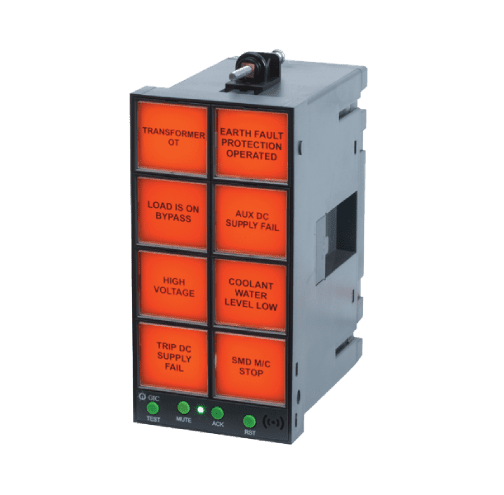
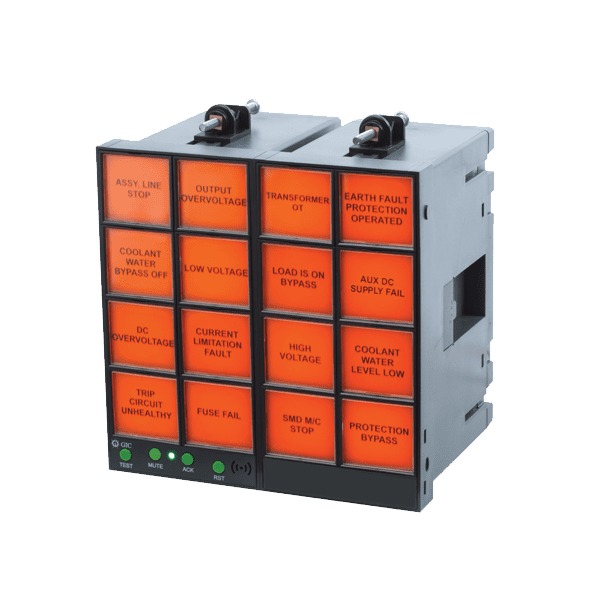
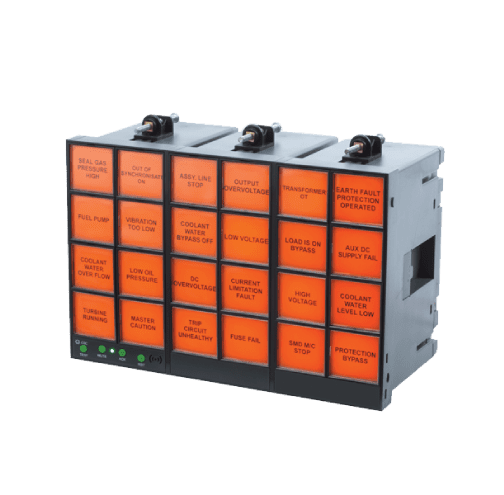
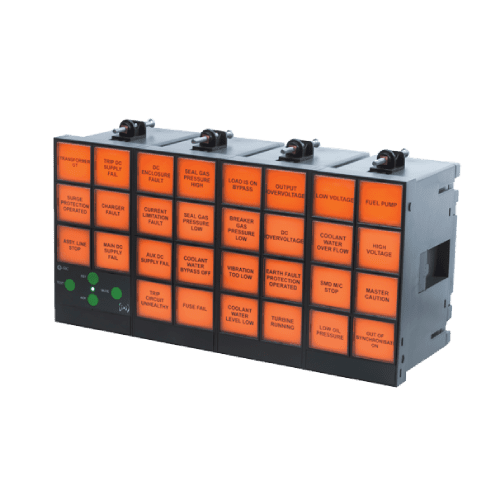
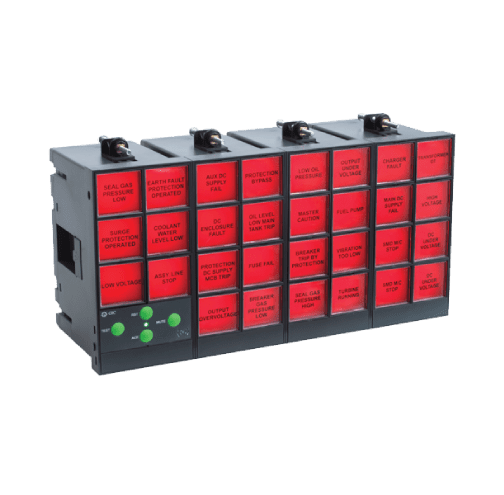
To illustrate, consider a power plant where an 8, 16, 32 or 48 window annunciator is deployed. It monitors various parameters such as temperature, pressure, and voltage levels. In the event of an abnormal condition, the Annunciator triggers audible and visual alarms, alerting operators to take necessary measures. This proactive response can prevent equipment damage, and unplanned downtime, and even ensure the safety of personnel.

Working Principle of GIC’s Alarm Annunciator

Whenever there is a change of input contacts from Normally Open to Close or from Normally Close to Open position, the annunciator changes from a rest condition to an alarm condition. Hence there is an immediate recognition of fault input which will have a corresponding visual and audio alarm as per the particular selected program sequence. The base unit of the 8, 16, 32 and 48 window annunciator has four programmable keys for the Mute, Acknowledge, Reset & Test functions. On pressing the Mute key the internal buzzer can be deactivated. Acknowledge key is used to accept the fault condition, The reset key enables resetting the alarm annunciator to its default state and the Test key helps to perform the complete test of the system.

Features

  • Standard models available from 2 to 48 windows
  • Choice of 3 window sizes and 6 different window colours
  • Optically isolated fault inputs with wide fault input voltage range (12 – 240V AC/DC +/-10%)
  • Field selection for NO / NC fault input contacts, a grouping of alarms, window size configuration
  • Space saving due to the lower depth of only 100mm
  • Integral push buttons for Test, Acknowledge, Mute and Reset operations
  • Four SPDT relay outputs (2 for grouping, 1 for external hooter, 1 for ring back sequence)
  • 6 Field selectable operation sequences as per ISA standard
  • Integral buzzer for audible alarm output of 90 dB
  • Communication interface with RS485 Modbus RTU protocol
  • Replaceable LEDs, Fast Scan, Manned / Unmanned, Supervisory Relay & Supply fail annunciation available

Frequently Asked Questions

An alarm annunciator is a device that gives visual and audio indications of the occurrence of a fault in a machine or a process.

The purpose of an annunciator is to monitor the health of a machine or process. On the occurrence of an abnormal condition in a machine or process. The annunciator gives visual and audio indications to fetch the attention of the operator or supervisor towards the abnormal condition to timely rectify the fault. It also enhances the machine’s life and reduces the breakdown time of the process.

The different types of annunciators are as follows:

  • Fast Scan Annunciator
  • Slow Scan annunciator
  • AC/DC or AC/AC or DC/DC fail annunciator
  • Basic annunciator
  • Annunciator with replaceable LEDs, etc.
The alarm panel can be only an indicative panel. Annunciator also comes with RS485 communication so that faults can be monitored through SCADA. Annunciators also follow the ISA18.1 standard for a sequence of operations to be followed on the occurrence of faults.
One window signifies one fault, likewise in Annunciator no. of faults ranges from 2 to 48 windows to monitor 2 to 48 faults.
The size of the annunciator windows are 30x30mm, 60x30mm, 60x60mm.
The standard models are available from 2 to 48 windows

  • Choice of 3 window sizes and 6 different window colours
  • Optically isolated fault inputs with wide fault input voltage range (12 – 240V AC/DC +/-10%)
  • AC-DC Fail Annunciation
  • Field selection for NO / NC fault input contacts, a grouping of alarms, window size configuration
  • Space saving due to a lower depth of only 100mm
  • Integral push buttons for Test, Acknowledge, Mute and Reset operations
  • Four SPDT relay outputs (2 for grouping, 1 for external hooter, 1 for ring back sequence)
  • 7 Field selectable operation sequences as per ISA standard
  • Integral buzzer for audible alarm output of 90 dB
  • Communication interface with RS485 Modbus RTU protocol
  • Replaceable LEDs, Fast Scan, Manned/Unmanned, Supervisory Relay & Supply fail annunciation available
We give the modular design in Annunciator with multiple of 8 faults in the form of Base+Extension.